
The Future of .NET: Trends and Predictions for 2026
The software development landscape is constantly shifting, with frameworks rising and falling in popularity based on their ability to adapt to new demands. For years, .NET has remained a cornerstone for enterprise applications, evolving from a Windows centric framework to a cross-platform powerhouse. As we look toward 2026, the trajectory of .NET suggests a deep integration with artificial intelligence, cloud native architectures, and performance optimizations that will redefine how developers build scalable systems.
In this article, we’ll explore the key trends shaping the future of .NET. You’ll learn about the anticipated advancements in AI integration, the shift towards platform engineering, and how the ecosystem is preparing to meet the high-performance needs of modern applications.
Deep Integration of Artificial Intelligence
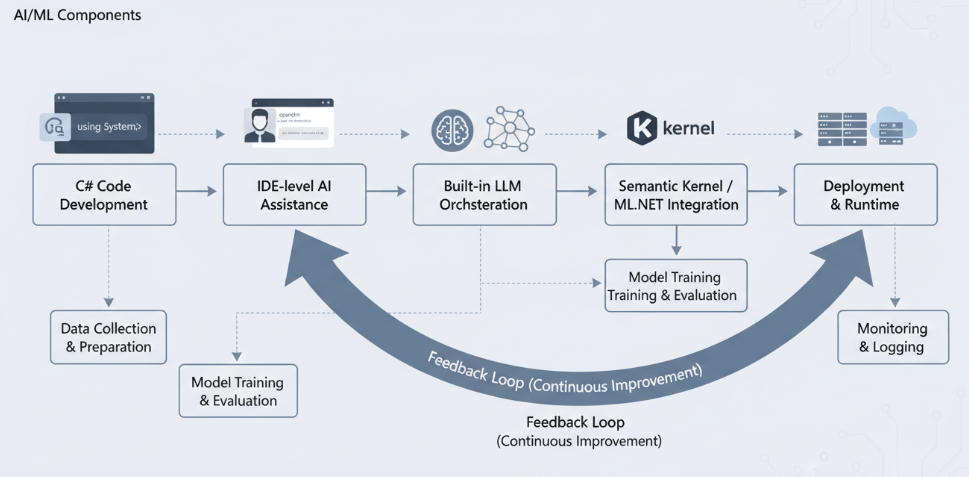
By 2026, AI won’t just be an add-on; it will be a native component of the development lifecycle within the .NET ecosystem. Microsoft has already laid out the groundwork with initiatives like ML.NET and semantic kernel integrations, but the next few years will see a significant leap in how these tools are embedded into daily workflows.
Seamless LLM Orchestration
The days of struggling with complex API bindings for Large Language Models (LLMs) are numbered. We predict that .NET 10 (likely the version in focus by 2026) will feature built in libraries that treat LLM orchestration as a first-class citizen. This means developers will be able to invoke AI capabilities such as text generation, code analysis, and natural language query processing using standard C# patterns, without relying heavily on third party wrappers.
Intelligent Code Assistance
While tools like GitHub Copilot are already external aids, the IDE itself (Visual Studio and VS Code) will likely incorporate deeply integrated, context aware AI that understands the specific architecture of your .NET solution. This goes beyond autocomplete; imagine an AI that can refactor legacy implementations to modern .NET standards or automatically generate unit tests based on business logic changes, all within the compile loop.
The Rise of Cloud Native by Default
Cloud native development has been a buzzword for a decade, but for .NET developers in 2026, it will be the default operating mode. The friction between local development and cloud deployment is set to disappear almost entirely.
.NET Aspire and Beyond
With the introduction of .NET Aspire, Microsoft signaled a clear intent to simplify building distributed, cloud native applications. By 2026, we expect this opinionated stack to be the standard for new greenfield projects. It will likely evolve to include:
- Automatic Infrastructure Provisioning: Defining your application code will automatically infer the necessary cloud infrastructure (IaC), whether on Azure, AWS, or Google Cloud.
- Zero Config Observability: Advanced telemetry and distributed tracing will be enabled out of the box, allowing developers to visualize microservice interactions instantly without complex OpenTelemetry configurations.
Native AOT Maturity
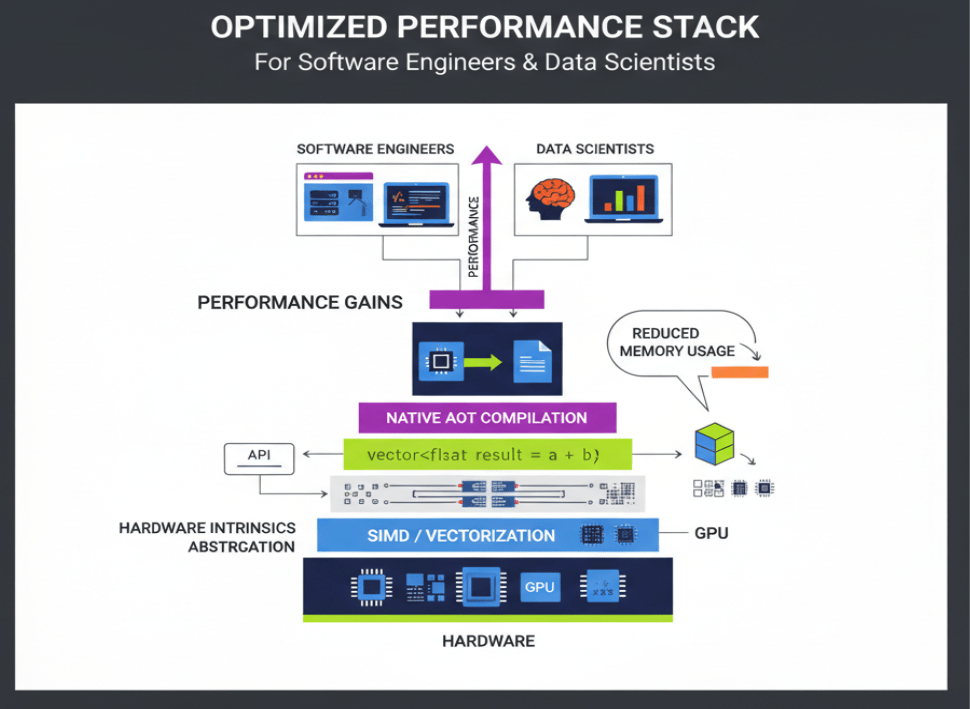
Native Ahead of Time (AOT) compilation has been improving steadily. By 2026, widespread adoption across mainstream libraries (including EF Core and ASP.NET Core) will be the norm. This shift is critical for serverless functions and containerized microservices, where cold start times and memory footprint are major cost drivers. Expect Native AOT to be the default build configuration for cloud deployed applications, drastically reducing operational costs.
Cross Platform UI: MAUI’s Evolution
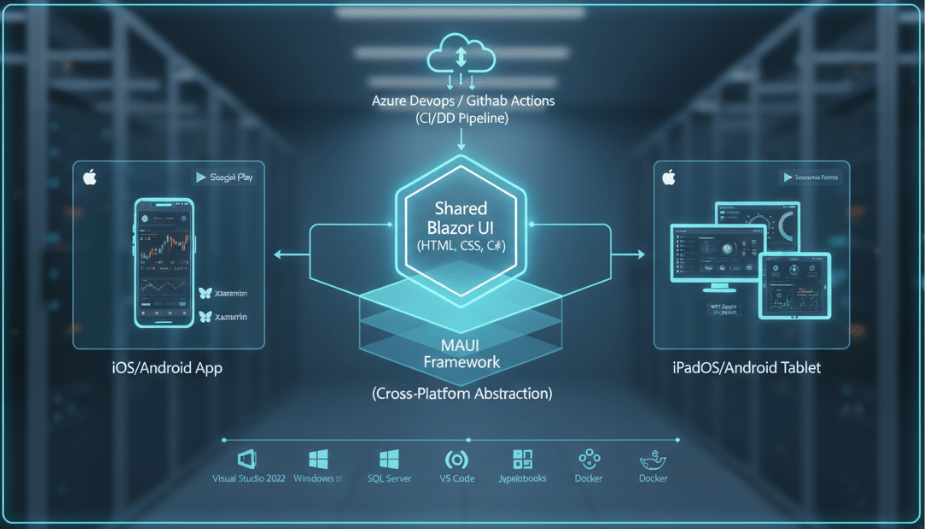
The Multi-platform App UI (.NET MAUI) has had a rocky start, but the demand for a unified codebase across mobile and desktop remains high. The prediction for 2026 is a stabilized, mature ecosystem that finally delivers on the “write once, run anywhere” promise without the performance penalties seen in earlier versions.
Blazor Hybrid Dominance
We anticipate a surge in Blazor Hybrid applications. Rather than building pure native UIs, enterprises will leverage their web development skills to build interfaces that run natively on devices. This approach reduces the context of switching for teams, allowing web developers to maintain mobile apps using HTML, CSS, and C#, all while accessing native device capabilities.
C# Language Enhancements
C# continues to evolve, balancing ease of use with high performance capabilities. Looking ahead to C# 14 or 15, the language design team is likely to focus on reducing boilerplate and improving memory safety.
- Expanded Pattern Matching: Expect even more expressive pattern matching capabilities that make functional programming styles more accessible and readable.
- Memory Safety Features: Borrowing concepts from Rust, C# may introduce stricter compile time checks for memory management in high performance contexts, reducing the likelihood of runtime exceptions in critical systems.
- Roles and Extensions: The “roles” proposal (an evolution of extension methods) could allow developers to treat lightweight types as if they implemented interfaces, enabling cleaner polymorphism without the allocation of overhead.
Performance: The Relentless Pursuit of Speed
Performance is a key success indicator for any tech stack. The .NET team has consistently proven that managed languages can compete with C++ and Rust. In 2026, performance optimizations will likely focus on:
Vectorization and Hardware Intrinsics
As AI and data processing workloads grow, utilizing the full power of modern CPUs (and GPUs) becomes essential. .NET will likely abstract complex hardware intrinsics even further, allowing standard LINQ queries or data processing loops to automatically utilize SIMD (Single Instruction, Multiple Data) vectorization without the developer needing to write unsafe code.
Green Coding
Sustainability is becoming a technical requirement. Optimized code consumes less energy, which translates to lower cloud bills and a smaller carbon footprint. .NET’s improvements in runtime efficiency and AOT compilation will be marketed not just as performance boosters, but as eco-friendly features essential for corporate sustainability goals.
Preparing for 2026
The future of .NET is robust, focusing on removing the “plumbing” code that slows developers down. The ecosystem is pivoting to support the high demands of AI, the scalability of the cloud, and the efficiency of modern hardware.
To stay ahead of these trends, we recommend:
- Experimenting with .NET Aspire: Get comfortable with the cloud native mindset now.
- Adopting Native AOT: Start testing your current applications for compatibility with AOT compilation.
- Exploring AI Integration: Don’t just use AI tools; learn how to integrate AI models into your C# applications using Semantic Kernel or ML.NET.
By aligning your skills with these predictions, you ensure that your projects remain scalable, efficient, and ready for the next generation of software challenges.

 Print on Demand Cloud
Leave a comment