
The Benefits of Hybrid Cloud Solutions for Enterprises
For modern enterprises, the debate between public and private clouds is often settled not by choosing one, but by choosing both. As data complexity grows and the need for scalable AI solutions intensifies, the hybrid cloud model has emerged as the architectural standard for forward thinking organizations.
In this article, you’ll learn:
- How hybrid cloud architectures bridge the gap between premises security and public cloud scalability.
- The specific benefits for AI developers and data scientists managing complex workloads.
- Key considerations for implementing a hybrid strategy that optimizes cost and performance.
- Real world scenarios where hybrid solutions outperform single cloud deployments.
Defining the Hybrid Cloud Landscape
A hybrid cloud environment mixes two or more distinct cloud infrastructures typically a private cloud (on premises or hosted) and a public cloud (like AWS, Azure, or Google Cloud) that remain unique entities but are bound together by standardized or proprietary technology that enables data and application portability.
For software engineers and data scientists, this isn’t just about storage locations; it’s about workload orchestration. It allows you to keep sensitive, mission critical data secured on your private infrastructure while bursting high demand processing tasks like training large language models (LLMs) or processing unstructured big data to the public cloud.
1. Optimized Scalability and Agility
One of the primary drivers for hybrid cloud adoption is the ability to scale resources dynamically. In a traditional prem environment, scaling requires purchasing, installing, and configuring physical hardware as a process that is often too slow for the rapid pace of AI development cycles.
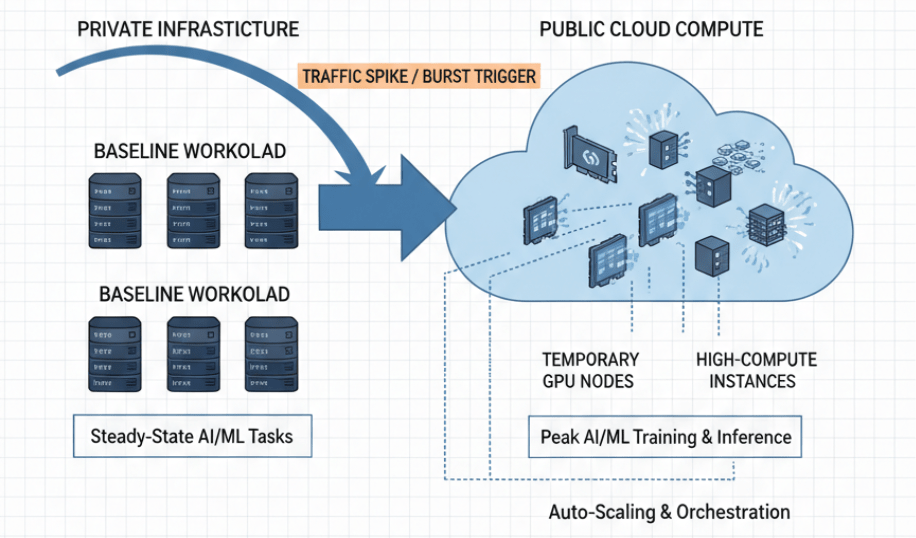
With a hybrid approach, you can maintain a steady state baseline of resources on your private cloud for predictable workloads. When demand spikes perhaps during a product launch or a heavy data ingestion period, you can seamlessly “burst” to the public cloud to access virtually unlimited compute power.
Performance Impact for AI Projects
- Model Training: Train models faster by offloading intensive epochs to high performance public cloud GPU clusters while keeping your core inference engines local.
- Testing Environments: Spin up temporary test environments in the public cloud without impacting your production environment on the private cloud.
2. Enhanced Security and Compliance
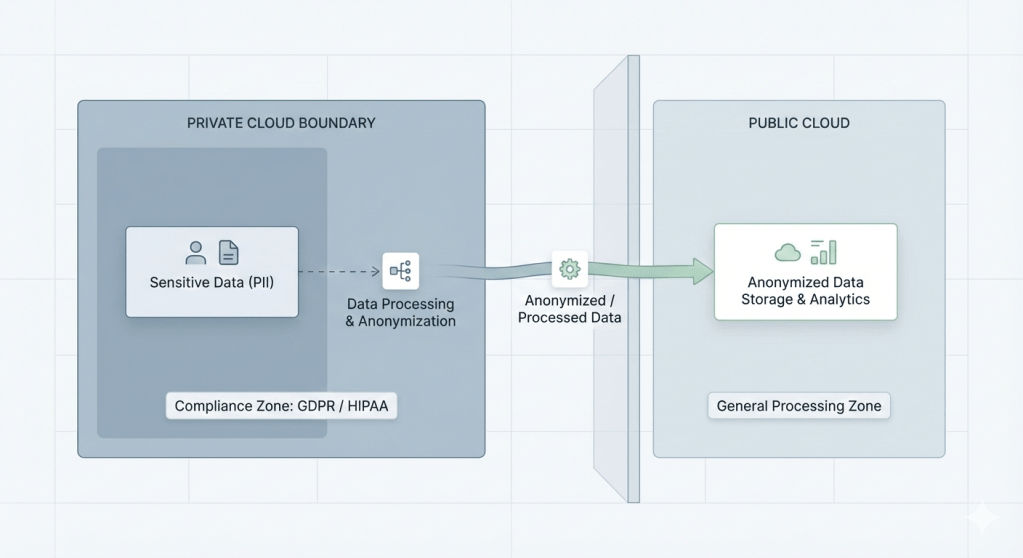
Data sovereignty and compliance are nonnegotiable for industries like finance and healthcare. A purely public cloud strategy can sometimes complicate compliance with regulations like GDPR or HIPAA, where specific data residency requirements must be met.
Hybrid cloud solutions offer the granularity needed to navigate these constraints. You can architecture your system so that sensitive customer data (PII) never leaves your private data center, while anonymized datasets are sent to the public cloud for machine learning analysis. This segmentation ensures you reap the benefits of advanced analytics without compromising security protocols.
3. Cost Efficiency and Resource Allocation
While the public cloud offers flexibility, it can become prohibitively expensive if not managed correctly, particularly for long running processes or massive data egress. Conversely, maintaining a private data center has high capital expenditure (CapEx) but lower operational expenditure (OpEx) for predictable workloads.
A hybrid cloud strategy allows for cost optimization by placing workloads where they are most economically viable.
- Cold Data Storage: Archive legacy data for low-cost public cloud storage tiers.
- Predictable Workloads: Run 24/7 core applications on private infrastructure to avoid accumulating hourly public cloud costs.
- Variable Workloads: Utilize public cloud instances for temporary, high compute tasks, paying only for what you use.
4. Accelerated Innovation and Time to Market
Speed is a competitive advantage. Hybrid cloud environments empower development teams to innovate faster by reducing infrastructure friction. Developers can utilize platforms as a service (PaaS) offering in the public cloud to build and deploy applications rapidly, without waiting for internal IT provisioning.
Once an application is mature or requires specific compliance controls, it can be moved to the private environment. This flexibility supports a robust CI/CD pipeline, enabling seamless integration and continuous delivery of new features.
5. Improved Business Continuity and Disaster Recovery
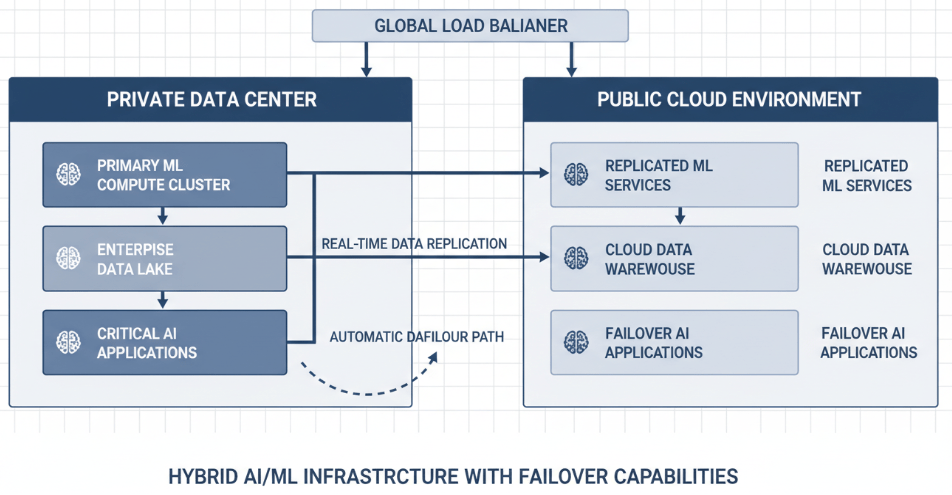
Resilience is critical. Relying on a single cloud vendor or a single physical data center introduces a single point of failure. A hybrid cloud architecture inherently diversifies this risk.
By replicating data and applications across both private and public environments, you create a robust disaster recovery strategy. If your private data center experiences an outage, critical workloads can fail over to the public cloud, ensuring minimal downtime and maintaining business continuity.
Implementing a Hybrid Strategy: Key Technical Considerations
Transitioning to a hybrid cloud is not without its challenges. For successful implementation, engineering teams must address several technical factors:
Network Connectivity
Low latency and high bandwidth are essential for the smooth movement of data between environments. Dedicated connections (like AWS Direct Connect or Azure ExpressRoute) are often required to ensure consistent performance.
Data Integration
Ensuring data consistency across environments is complex. Tools that support data virtualization or replication are necessary to maintain a single source of truth.
Containerization
Technologies like Docker and Kubernetes are the linchpins of modern hybrid cloud deployments. By containerizing applications, you decouple them from the underlying infrastructure, making them truly portable across private and public clouds.
Strategic Next Steps for Enterprises
The hybrid cloud is not merely a steppingstone; for many enterprises, it is the destination. It offers a pragmatic balance between the control of on-premise infrastructure and the expansive power of the public cloud.
To further improve your infrastructure strategy and build reliable, scalable AI solutions, we recommend:
- Audit your current workloads: Identify which applications require the elasticity of the public cloud and which demand the control of a private environment.
- Evaluate containerization readiness: Assess if your current application stack is ready for container-based deployment to facilitate portability.
- Explore hybrid management tools: Investigate platforms that provide a unified pane of glass for managing resources across distinct environments.

 Print on Demand Cloud
Leave a comment