
The Future of Web Frameworks: Trends and Predictions for 2026
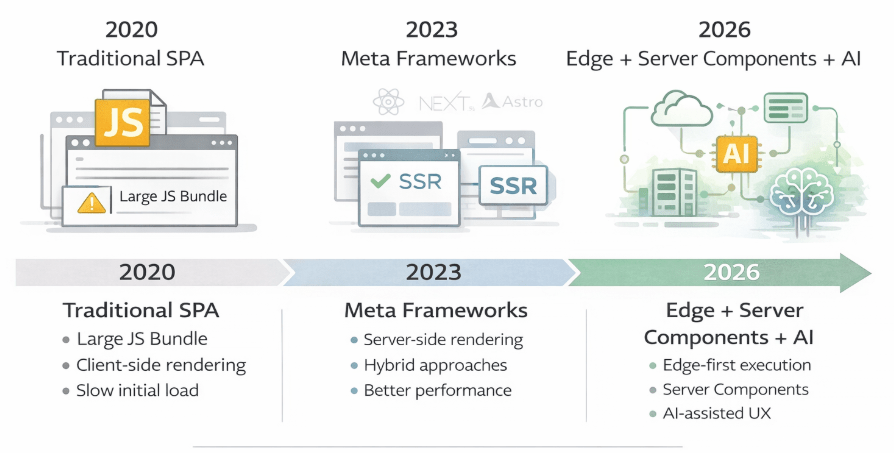
If you paused your coding education in 2020 and woke up today, the landscape of web development would look almost alien. We’ve moved from simple single page applications (SPAs) to complex meta frameworks, server components, and edge rendering. The rate of change in the JavaScript ecosystem is notorious, often leading to “decision fatigue” for developers and CTOs alike.
However, as we look toward 2026, the chaos seems to be coalescing into clarity. The next generation of web frameworks isn’t just about adding new features; it is fundamentally rethinking how we deliver code to the browser. The focus is shifting away from massive client-side bundles toward performance, sustainability, and intelligent server utilization.
Navigating these shifts is essential for anyone planning a tech stack for the long haul. Here is what the landscape of web frameworks will likely look like by 2026, and the trends driving those changes.
The End of “Hydration” as We Know It
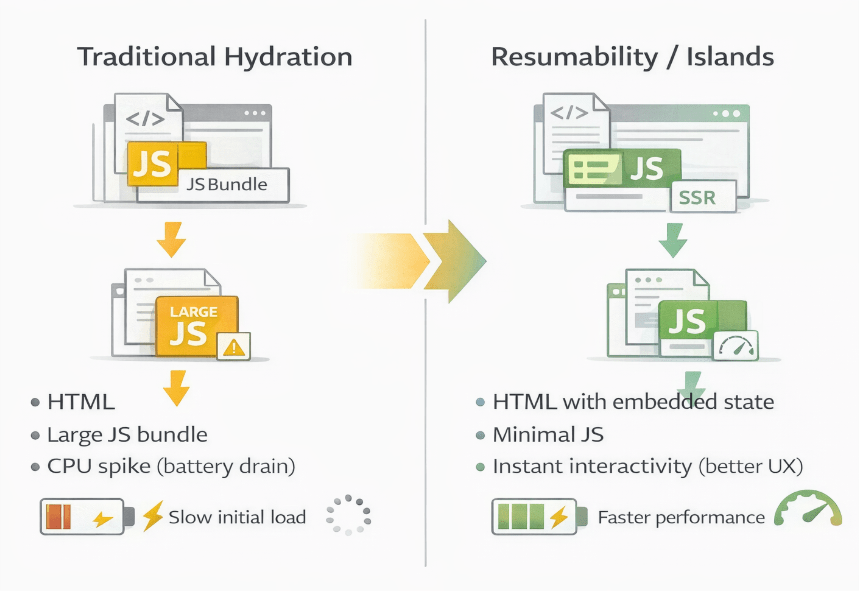
For the better part of a decade, the standard model for modern web apps has been “hydration.” You send a skeleton HTML page to the browser, then load a massive JavaScript bundle to “wake up” the page and make it interactive. While this enabled dynamic user experiences, it came at a heavy cost: slow Time to Interactive (TTI) and battery draining CPU usage on mobile devices.
By 2026, we predict that traditional full-page hydration will be viewed as an anti-pattern. We are already seeing the precursors to this shift with technologies like Qwik and Astro.
Resumability and Islands
Newer architectures focus on “resumability.” Instead of rerunning JavaScript to attach event listeners (hydration), frameworks are serializing the event data into the HTML itself. The application can “resume” on the client exactly where the server left off, with zero initialization cost.
Similarly, the “Islands Architecture” popularized by Astro encourages developers to ship static HTML by default, only loading JavaScript for specific interactive components (islands). By 2026, this won’t be a niche optimization; it will likely be the default behavior for major frameworks. The days of shipping 500KB of JavaScript to render a blog post are numbered.
The Edge Becomes the Default Backend
Historically, frameworks were designed to run on a centralized server (like Node.js running on a Linux box) or entirely in the browser. The rise in Edge computing is blurring this line significantly.
Edge networks allow code to run on servers distributed globally, physically closer to the user. Currently, frameworks like Next.js and Remix adapt to this by allowing specific API routes to run on the Edge. By 2026, we expect frameworks to be “Edge native” by default.
This shift means frameworks will be opinionated about data residency. They will intelligently decide which parts of your application should run near the user (for speed) and which parts should run near your database (for data integrity), likely without the developer needing to configure it manually. The framework will act as a compiler that optimizes your infrastructure distribution automatically.
AI Assisted Frameworks
Artificial Intelligence is currently an external tool we use to write code (like GitHub Copilot). By 2026, AI will likely be deeply integrated into the frameworks themselves.
We are approaching an era where boilerplate code is managed entirely by AI agents. Frameworks might evolve to be more declarative, describing what the result should be, while leaving the specific implementation details to an AI compiler layer.
Imagine a framework where you define your data schema and your UI design tokens, and the framework’s CLI generates the type of safe connectivity, API endpoints, and validation logic automatically. This reduces the cognitive load on developers, allowing them to focus on business logic rather than wiring together components.
The Rustification of Tooling
While JavaScript (and TypeScript) will remain the language of the web, the infrastructure powering our frameworks is rapidly moving to lower-level languages like Rust and Go.
We have already seen this with tools like SWC (replacing Babel) and Turbopack (replacing Webpack). These tools are orders of magnitude faster than their JavaScript predecessors. By 2026, this transition will be complete. The entire build chain linting, compiling, bundling, and testing will happen instantly.
This speed isn’t just a quality-of-life improvement; it changes how we build. When compilation is instant, the feedback loop tightens. Frameworks will be able to perform much more aggressive optimizations and static analysis during development because the cost of “building” the project will be negligible.
Full Stack Typesafety and the Death of the API Layer
The separation between frontend and backend is becoming increasingly porous. In the past, you built a backend API, documented it, and then wrote a frontend that fetched data from that API. If you changed the backend, the frontend broke unless you manually updated it.
Trends indicate that by 2026, manually writing API fetch requests will be obsolete for internal application logic.
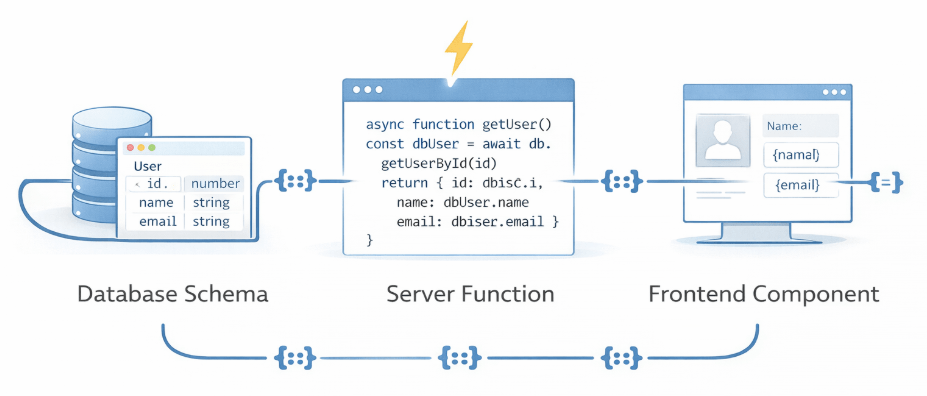
Frameworks are moving toward Remote Procedure Calls (RPC) and Server Actions. You simply write a function on the server, import it into your frontend component, and call it. The framework handles network requests, error handling, and serialization. Most importantly, it preserves TypeScript types across the network boundary. If you change the database model on the server, your frontend button immediately shows a type of error. This “end to end typesafety” drastically reduces bugs and speeds up development cycles.
Framework Agnosticism and Web Components
Framework locking is a major risk for businesses. Rewriting an application from Angular to React, or React to Svelte, is an expensive nightmare.
To combat this, we are seeing a resurgence of interest in standard Web Components but wrapped in better developer ergonomics. Tools like Lit are gaining traction for building design systems that work anywhere.
In 2026, we predict a trend toward “Bring Your Own Component” meta frameworks. You might use a solid overarching meta framework for routing and data fetching, but the leaf nodes the buttons, inputs, and cards could be built in Vue, React, or Svelte, and coexist peacefully on the same page. The framework of wars might end not with a winner, but with a treaty of interoperability.
Preparing for the Shift
The future of web frameworks is efficient, distributed, and intelligent. The era of “move fast and break things” is evolving into “move fast and build stable, performant systems.”
For developers and organizations, the best way to prepare for 2026 is to chase every new library that trends on Twitter (X). Instead, focus on the fundamental shifts: understanding server-side architecture, mastering TypeScript, and prioritizing performance metrics like Core Web Vitals. The specific syntax of a framework may change, but the principles of efficient delivery and user experience are here to stay.
Keep experimenting, stay curious, and don’t be afraid to let go of old patterns when better solutions arrive.

 Print on Demand Cloud
Leave a comment