
Why Modern Web Frameworks Are The Secret to Scalable PWA Development
If you’ve been tracking the trajectory of web development, you know the promise of Progressive Web Apps (PWAs): the reach of the web with the performance of native apps. But here’s the problem: simply tacking a service worker onto a legacy codebase doesn’t cut it anymore. As user expectations for “app like” fluidity skyrocket, the bottleneck isn’t the browser capabilities, it’s the architecture beneath them.
This article argues that your choice of web framework isn’t just a syntax preference; it is the single most critical factor in PWA performance and scalability. We will dissect how modern frameworks handle the heavy lifting of state management and rendering, turning potential performance pitfalls into your competitive advantage.
The “Why Now?” of PWA Architecture
Why are we having this conversation now? In the last 12 months, the browser landscape has shifted dramatically. With Safari finally improving support for PWA features like Push Notifications and the File System Access API becoming more robust in Chromium, the gap between native and web capabilities has narrowed significantly.
However, the “old way” of building web apps relying on heavy DOM manipulation and monolithic page loads is failing to keep up with these new capabilities. Traditional architectures struggle to maintain 60fps scrolling while handling complex service worker caching strategies and background syncs.
For developers accustomed to high performance computing, the inefficiency of the DOM is glaring. We need frameworks that abstract this complexity, treating the UI as a function of state rather than a mutable document. This shift is essential because:
- Complexity Management: As PWAs gain features (offline mode, background sync), the logic required to manage them grows exponentially.
- Performance Metrics: Core Web Vitals are now ranking factors. Frameworks that offer hydration strategies and code splitting out of the box are no longer optional, they are requirements.
- Device Fragmentation: Your PWA needs to run smoothly on a high-end desktop and a mid-range mobile device. Frameworks provide the abstraction layer to handle these disparities.
The Core Mechanism: How Frameworks Optimize PWAs
At a technical level, modern frameworks like React, Vue, and Angular (along with meta frameworks like Next.js or Nuxt) solve specific PWA challenges through Virtual DOMs and intelligent build processes. Let’s break down the mechanism of how they facilitate superior PWA development.
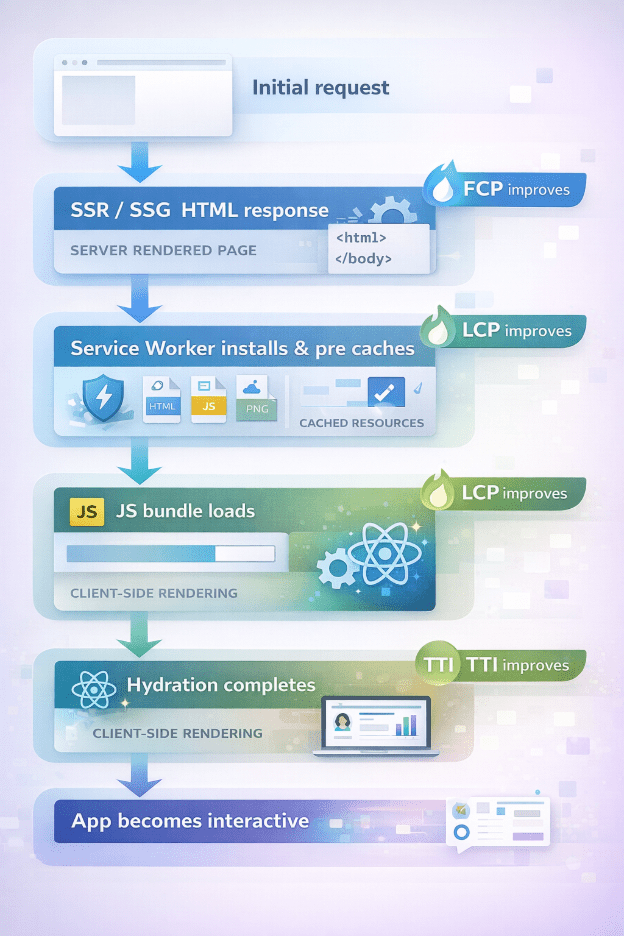
1. The Service Worker Abstraction
Writing a raw service worker code is error prone. Frameworks often provide modules (like Next.js’s next pwa or Angular’s @angular/service worker) that automate the generation of the service worker file.
- Pre-catching: The build process identifies critical assets (CSS, JS bundles, shell HTML) and hashes them. The service worker config acts as a manifest, ensuring the correct version is cached immediately upon the first load.
- Runtime Caching: Frameworks allow you to define strategies (Network First, Cache First, Stale While Revalidate) via configuration rather than boilerplate code.
2. Hydration and Code Splitting
In a PWA, the “App Shell” model is crucial. The framework separates the UI shell (header, navigation) from the dynamic content.
- Server-Side Rendering (SSR) & Static Site Generation (SSG): Frameworks render the initial HTML on the server. The user sees content immediately (improving First Contentful Paint).
- Hydration: Once the JS bundle loads, the framework “hydrates” the static HTML, turning it into a fully interactive React/Vue app.
- Route Based Splitting: Instead of downloading a 5MB bundle, the framework splits code by route. If a user visits /dashboard, they only download the code for the dashboard, not the settings page.
3. State Management as the Source of Truth
In a PWA, “offline” is just another state. Frameworks utilize stores (Redux, Pinia, NgRx) to manage this data. When the network cuts out, the UI reacts to the change in the state store, perhaps queuing a mutation (like a form of submission) in IndexedDB to be synced later. The framework handles the UI updates seamlessly, so the user experience remains uninterrupted.
Real World Impact: From Theory to Practice
Let’s look at how this architectural choice plays out in production environments where performance and scalability are non-negotiable.
Case Study: E Commerce Scalability
Consider a large-scale e-commerce PWA built with Next.js. By utilizing the framework image optimization and incremental static regeneration (ISR), the platform can serve thousands of product pages that are statistically generated (fast) but updated in the background (fresh).
- Result: A 40% reduction in Time to Interactive (TTI) compared to a client side only approach. The service worker precaches the top 10 most visited products based on analytics data, making the shopping experience instant even on 3G networks.
Case Study: Financial Data Dashboard
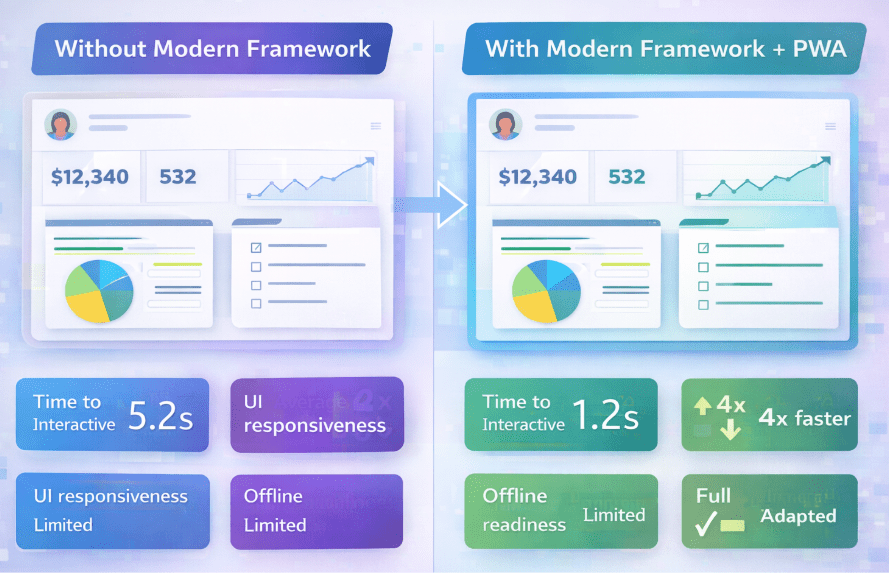
A fintech application requires real-time data visualization. Using a raw JavaScript approach resulted in UI freezing during heavy data intake. By switching to a framework using a Virtual DOM (like React) coupled with Web Workers, the application offloaded the heavy data parsing to a background thread.
- Result: The main thread remained free for UI responsiveness. The framework efficiently diffed the DOM updates, rendering changes only where necessary. This integration improved the application’s responsiveness score by over 50%.
These examples highlight that utilizing a robust framework doesn’t just make writing code easier; it fundamentally changes the performance profile of the final application.
Challenges and Ethics:
Adopting a heavy-duty framework for PWA development isn’t without its criticisms. We must address the tradeoffs regarding cost, complexity, and privacy.
The Bundle Size Bloat
The Concern: “Frameworks add too much overhead. I don’t need 100kb of JavaScript just to render a blog.”
The Reality: This is a valid concern for simple sites. However, for complex enterprise applications, the “tree shaking” capabilities of modern build tools (Webpack, Vite) integrated into these frameworks often result in smaller effective bundles for the user than manual implementations, as unused code is stripped away automatically during the build process.
The Learning Curve and Cost
The Concern: “My team knows Python and basic JS. Learning a full stack meta framework takes months.”
The Reality: There is an initial training cost ($10K $100K range depending on team size). However, the long-term ROI comes from reduced maintenance. Frameworks enforce structure. A specialized PWA framework prevents “spaghetti code” in the service worker logic, which is notoriously difficult to debug.
Privacy and Data Handling
The Concern: “Do these frameworks leak data?”
The Reality: Frameworks themselves are generally agnostic, but the dependencies they pull in can be a risk. It is vital to audit supply chains. Furthermore, because PWAs rely heavily on client-side storage (IndexedDB), developers must ensure sensitive financial or healthcare data is encrypted at rest within the browser; a feature framework don’t always handle out of the box.
Conclusion
The era of hand rolling complex PWAs is ending. As the demand for offline first, high performance web applications grows, the role of the web framework has shifted from a helper tool to critical infrastructure.
For teams building in tech, finance, and healthcare, the path forward is clear: leverage frameworks that prioritize the App Shell model, offer robust state management, and automate the complexities of the service worker lifecycle.
Ready to optimize your development stack?
Don’t let legacy architecture slow down your deployment. Start by evaluating your current framework’s support for modern PWA standards. If you are looking for scalable solutions that integrate seamlessly with your existing data pipelines, explore our cloud based development tools today.

 Print on Demand Cloud
Leave a comment