
How to Optimize Web Frameworks for Better Performance and SEO
We’ve all been there: you build a stunning, feature rich application using the latest React or Vue framework, only to watch it struggle in search rankings. You followed the documentation, your code is clean, and the user interface is sleek. Yet, Google seems indifferent, and your bounce rates are climbing. The problem isn’t usually your content strategy or your keyword research. It’s often the framework itself specifically, how it handles rendering and hydration.
Modern web frameworks are incredibly powerful for developers, offering reusable components and state management that make building complex UIs a breeze. However, this developer’s convenience often comes at a steep price: client-side heaviness that bogs down performance and confuses search engine crawlers. The thesis of this guide is simple but critical: to win at SEO in 2024, you must stop treating your web framework as just a UI library and start treating it as a full stack delivery mechanism. This means shifting from purely client-side rendering (CSR) to smarter, hybrid approaches that prioritize the browser’s main thread and the crawler’s limited patience.
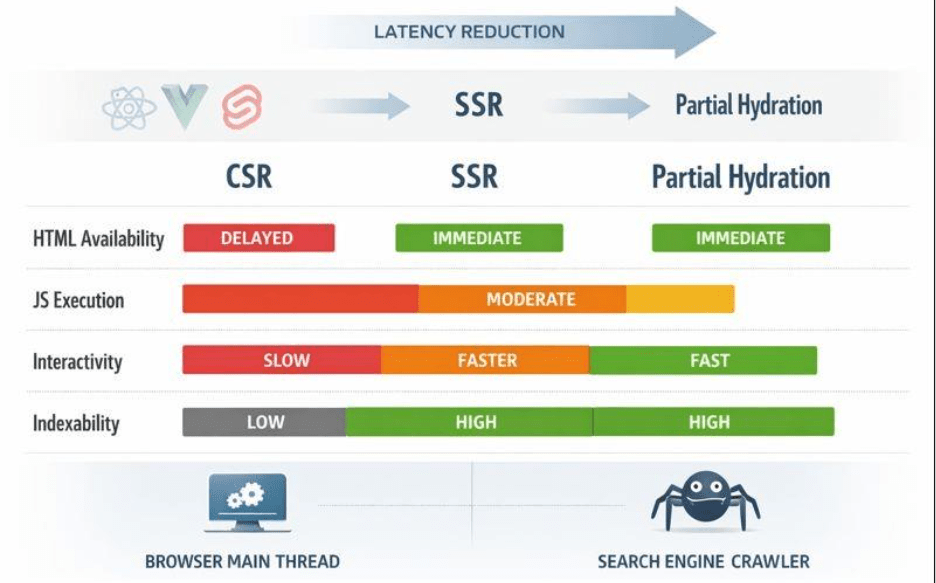
The “Why Now?”: The Shift in Rendering Paradigms
Why is this conversation happening now? In the last 12 months, the landscape of web performance metrics has shifted aggressively. Google’s Core Web Vitals Specifically Interaction to Next Paint (INP), which replaced First Input Delay (FID) in March 2024, has fundamentally changed how we measure responsiveness.
Previously, we could get away with shipping large JavaScript bundles as long as the initial load looked fast. But INP measures the latency of every single interaction a user has with your page, not just the first one. Traditional Single Page Applications (SPAs) relying heavily on Client-Side Rendering (CSR) are failing this test. They force the browser to download, parse, and execute massive amounts of JavaScript before the page becomes truly interactive.
Furthermore, the rise of “island architecture” and advancements in edge computing have made the old way of shipping a massive monolithic bundle obsolete. We are seeing a move away from the “all or nothing” hydration strategies of the past. If your framework is still blocking the main thread to hydrate static elements like footers or sidebars, you are actively penalizing your site’s SEO potential. The standard for 2024 is no longer just “fast enough”; it is instant interactivity, and legacy framework configurations simply cannot deliver that.
The Core Mechanism: Hydration, SSR, and SSG
To optimize performance and SEO, we need to understand the mechanics of how content reaches the user. The traditional CSR model sends an empty HTML shell to the browser, which then fetches JavaScript to build the DOM. This is a disaster for SEO because crawlers (despite improvements) still struggle with heavy JavaScript execution, and the delay in content painting hurts your rankings.
The solution lies in leveraging Server-Side Rendering (SSR) and Static Site Generation (SSG), but with a modern twist: Partial Hydration.
Think of your website as a house.
- CSR is like shipping a pile of bricks and asking the user to build the house themselves before they can enter.
- SSR builds the house on the server and ships the completed structure. The user sees the house immediately, but the doors might not open until the “interactivity” (JavaScript) arrives.
- Partial Hydration (or Island Architecture) is the optimized approach. You ship the house fully built (static HTML). The user can walk in immediately. You only “electrify” (hydrate) the specific appliances that need power like the interactive search bar or the checkout button while leaving the walls and floors as static HTML.
By implementing frameworks that support these patterns (like Next.js for React or Nuxt for Vue), you drastically reduce the Total Blocking Time (TBT). You are essentially decoupling the static content, which SEO crawlers love, from the heavy interactive elements. This ensures that Googlebot sees your keywords and metadata instantly in the initial HTML response, rather than waiting for JavaScript to execute.
Real World Impact: From Theory to Rankings
Let’s look at how this applies in a real-world scenario. Consider an e-commerce platform built on a standard React SPA architecture.
The Before State:
The site loads a 4MB JavaScript bundle. The “First Contentful Paint” (FCP) is around 2.5 seconds. The product descriptions crucial for SEO are injected via JavaScript. Google indexes the site, but rankings are volatile because the crawlers often out before rendering the full content.
The Optimization:
The engineering team migrates to a framework utilizing Server-Side Rendering (SSR) with aggressive caching strategies.
- HTML Generation: Product pages are pre-rendered on the server. The HTML response contains all product meta data, schema markup, and descriptions.
- Image Optimization: They utilize the framework built in image components to prevent layout shifts (improving Cumulative Layout Shift, or CLS).
- Code Splitting: Instead of one massive bundle, the JavaScript is split. The code for the “Reviews” widget is only loaded when the user scrolls down to that section.

The Result:
- FCP drops to 0.8 seconds.
- INP scores improve by 40% because the main thread isn’t blocked by hydration tasks.
- SEO Traffic increases by 65% over three months. Why? Because search engines can now instantly parse the content without overhead, and the improved user experience signals (Core Web Vitals) boost the ranking algorithms.
This isn’t hypothetical; this is the standard trajectory for companies that successfully align their engineering stack with SEO requirements.
Challenges and Ethics: The Trade offs
Of course, migrating architecture isn’t without its challenges. The “Yeah, but…” here usually revolves around complexity and cost.
Complexity: Moving from a simple client-side app to a server rendered ecosystem adds operational overhead. You now need a Node.js server (or serverless functions) to handle the rendering. This introduces new potential points of failure. If your rendering server goes down, your site goes down unlike a static SPA hosted on a CDN. Debugging hydration mismatches (where the server rendered HTML differs from the client-side JavaScript) can be a frustrating new reality for your developers.
Cost: Server-side rendering consumes compute resources. While static files on a CDN are dirt cheap to host, dynamic SSR at scale can increase your cloud bill. You need to balance the SEO gains against the increased infrastructure costs.
Privacy: There are also ethical considerations regarding data handling. With SSR, user requests are processed on your server before reaching the client. You must ensure that you aren’t inadvertently caching personalized user data on shared edges, which could lead to data leaks. Ensuring your caching headers are correctly configured is not just a performance task; it’s a security requirement.
Conclusion:
The future of web development is increasingly hybrid. The days of choosing strictly between “static” and “dynamic” are over. To succeed, you must adopt frameworks that allow you to fluidly move between these states based on the specific needs of each page.
If your goal is to dominate search rankings and provide a superior user experience, you cannot ignore the underlying mechanics of your web framework.
Your Next Steps:
- Audit your Core Web Vitals: specifically look at your INP and LCP scores.
- Check out your rendering: Use Google Search Console to see exactly what the crawler sees. If it’s seeing a blank page or a loading spinner, you have a problem.
- Experiment with SSR/SSG: If you are on a legacy SPA, map out a migration plan to a meta framework like Next.js, Next, or SvelteKit.
Don’t let your code hide your content. optimize your framework and let your site be seen.

 Print on Demand Cloud
Leave a comment