
The Rise of Serverless Computing: Why Developers Are Breaking Free from Server Slavery
Picture this: You’re trying to build a house, but instead of focusing on creating beautiful rooms and functional spaces, you spend 90% of your time maintaining the power grid and water supply for the entire neighborhood. Sounds absurd, right?
Yet that’s exactly what traditional server management feels like for developers. You want to write elegant code and build amazing features, but you end up babysitting infrastructure instead.
The good news? That era is ending.
We’re witnessing a seismic shift in how applications are built and deployed. Serverless architecture isn’t just another tech buzzword it’s a liberation movement that’s freeing software engineers from the chains of server maintenance. And the numbers speak for themselves: companies adopting serverless report up to 70% reduction in operational costs and 90% faster deployment times.
Ready to discover why serverless computing is revolutionizing everything from cloud app development to AI deployment? Let’s dive in.
What is Serverless Computing? (And Why the Name is Misleading)
Here’s the plot twist: despite the name, servers do exist in a serverless architecture. The magic is that you don’t have to worry about them.
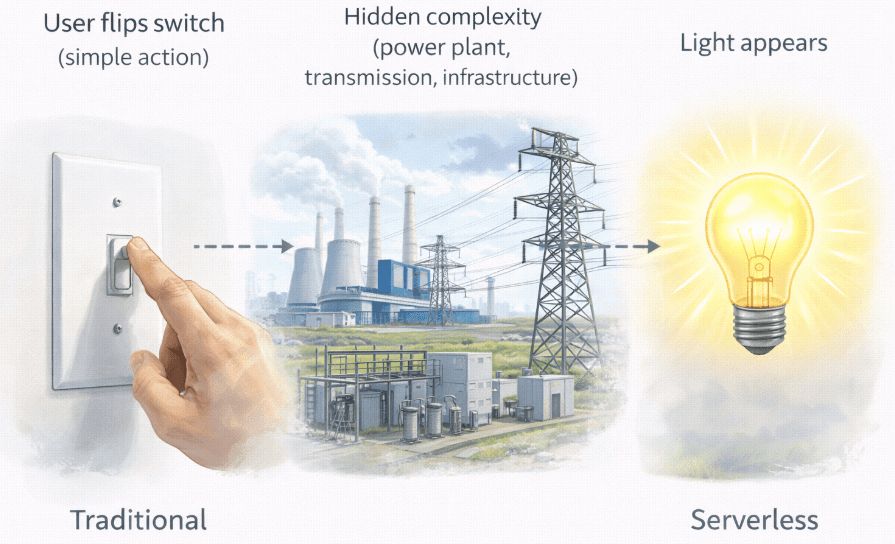
Think of it like this: When you turn on a light switch, you don’t think about the power plant, transmission lines, or electrical engineering behind it. You just get light. That’s serverless.
A third-party cloud provider (like AWS or Azure) handles all the messy infrastructure management for resource allocation, scaling, patching, security updates. Your job as a developer? Simply write code and deploy it. The cloud services provider executes that code in response to specific events.
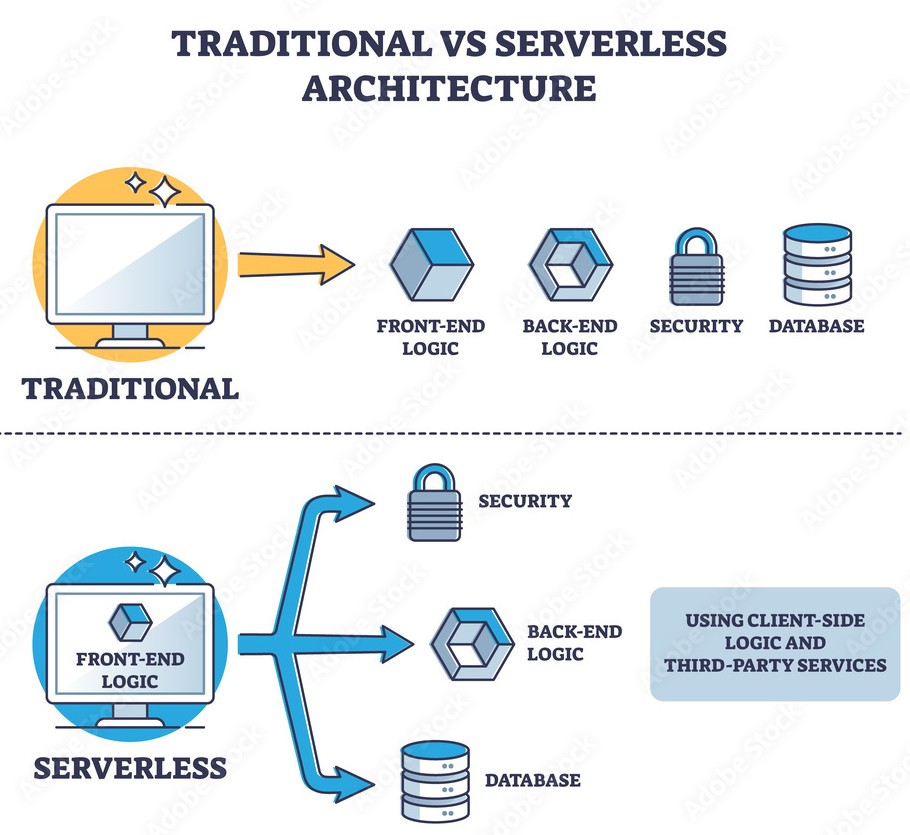
The Old Way vs. The Serverless Way
Traditional Cloud Computing:
The Architecture Burden:
- Provision servers – The guessing game: Will we need 5 or 50? Guess wrong and you either cash or waste money
- Pay for capacity 24/7 – Your servers run around the clock, even at 3 AM when nobody’s using your app. That’s money burning while you sleep
- Manually scale when traffic spikes – Frantically adding capacity when your app goes viral, hoping you’re fast enough
- Update, patch, and maintain everything yourself – You’re responsible for the entire stack: front-end logic, back-end logic, security patches, database maintenance, and every layer in between
Reality: You manage everything from the monitor to the database, spending more time on infrastructure than innovation.
Serverless Architecture:
The Liberation:
- Write your function – Focus purely on the front-end logic that matters. That’s it. That’s your job
- Deploy it – One command, and you’re live. No server setup, no configuration files, no infrastructure orchestration
- Pay only when it runs – Billing is measured in milliseconds of actual execution. Zero requests? Zero cost
- Automatic scaling – Seamlessly handles 10 users or 10 million users with zero configuration. The system expands and contracts instantly based on demand
The Magic: Back-end logic, security, and database connections are handled through client-side logic and third-party services. You leverage managed services instead of building and maintaining everything yourself.
The Bottom Line:
If your code isn’t running, you aren’t paying. Period. This is the fundamental shift: Traditional architecture charges you for potential, serverless charges you for reality. No more paying for idle servers. No more over-provisioning “just in case.” No more maintenance overhead stealing your development time. You write code. The cloud does everything else.
The Titans Leading the Charge: AWS Lambda vs. Azure Functions
Two tech giants are driving this revolution, each offering powerful tools that are reshaping software development.
AWS Lambda: The Pioneer
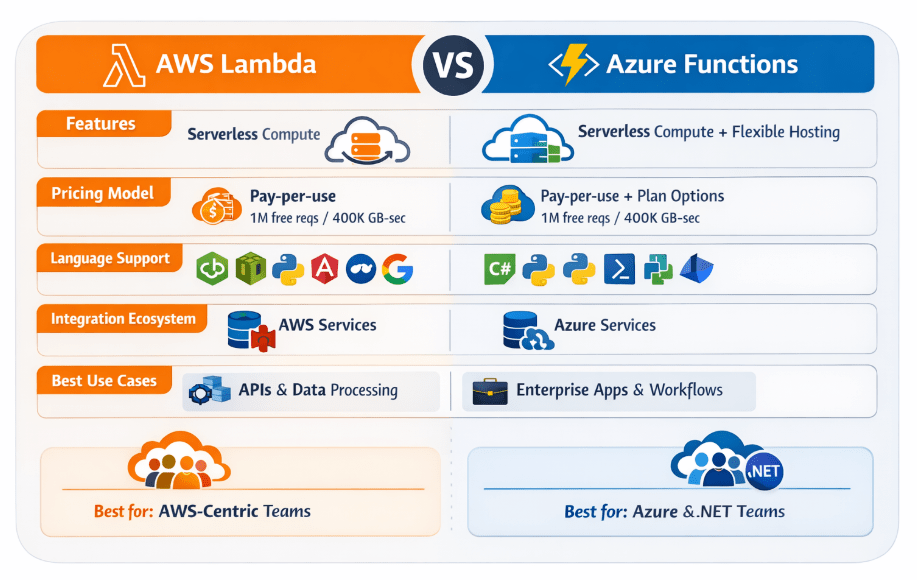
Amazon Web Services didn’t just enter the serverless game they created it. AWS Lambda allows you to run code without provisioning or managing servers, period.
When you leverage AWS cloud computing through Lambda, it automatically handles everything required to run and scale your code with high availability. The seamless integration with other AWS web services makes it the default choice for countless software development firms.
Real world impact: A mobile software development company recently shared how they reduced their monthly cloud bill from $12,000 to $800 by migrating background processing tasks to AWS Lambda. Same functionality, 93% less cost.
Azure Functions: Microsoft’s Powerful Alternative
Microsoft didn’t just copy Lambda they built something uniquely powerful. Azure Functions operates on similar principles but shines particularly bright for organizations already invested in the Microsoft ecosystem.
What sets Azure Functions apart? It excels at complex orchestration challenges and supports a wider range of programming languages out of the box. For enterprise software engineering teams already using Microsoft tools, it’s often the more natural fit.
5 Reasons Developers are Ditching Traditional Servers
The migration to serverless isn’t hype it’s solving real problems that developers face every single day.
1. Freedom to Actually Build Things
Remember why you became a developer? To create. To solve problems. To build features that delight users.
With serverless architecture, you finally can. When you eliminate the endless cycle of patching servers, managing operating systems, and worrying about capacity planning, your team can dedicate their energy to software development that actually moves the needle.
One engineering manager put it perfectly: “We went from spending 60% of our time on infrastructure to spending 95% on features. Our velocity tripled.”
2. Scaling That Actually Works
We’ve all heard the horror stories. Black Friday traffic surge crashes the e commerce site. A viral tweet brings down your app. A successful product launch… becomes a disaster.
In traditional setups, these scenarios require complex auto scaling configurations, load balancers, and crossed fingers. In a serverless environment? The cloud services provider automatically scales your application by spinning up instances in response to each trigger.
Your application handles 5 requests per day or 5 million per second with equal ease. No configuration required.
3. Pay Per Use Economics
For startups bootstrapping on ramen budgets and enterprises optimizing every dollar, this is game changing.
You’re charged based on actual execution time and number of requests. Not on capacity. Not on what might happen. On what does happen.
That idle server sitting there at 2% utilization all weekend? Gone. That’s real money back in your budget money any software development company can redirect toward growth instead of waste.
4. Faster Time to Market
In today’s competitive landscape, speed wins. The company that ships faster learns faster, iterates faster, and ultimately wins customers faster.
Serverless removes entire categories of work from your critical path. No server provisioning. No capacity planning. No infrastructure setup. You go from idea to deployed code in hours instead of weeks.
5. Built In High Availability
Remember being on call at 2 AM because a server went down? Serverless providers handle redundancy, failover, and disaster recovery automatically across multiple availability zones.
You get enterprise grade reliability without enterprise grade effort.
Game Changer for Mobile App Development
If you develop mobile app backends, serverless is about to become your best friend.
Mobile apps need to handle authentication, real time database updates, push notifications, image processing, and more. Traditionally, this meant building and maintaining a complex backend infrastructure.
Revolutionizing Android Software Development
For teams doing Android software development, serverless backends are a revelation. Developers working in Android Studio can connect their apps to cloud functions with minimal configuration.
Instead of architecting a monolithic backend API (and maintaining it forever), you write small, focused functions that each do one thing well:
- Process an image upload
- Authenticate a user
- Send a push notification
- Sync data across devices
Each function scales independently. Each deploys independently. Each can be written, tested, and updated without touching the others.
Why Development Agencies Are All In
Ask any modern mobile software development company about their go to architecture, and they’ll likely mention serverless. Why?
Speed. They can prototype in days instead of weeks.
Flexibility. Pivoting requires rewriting a few functions, not rebuilding infrastructure.
Client satisfaction. Lower costs and faster delivery make for very happy clients.
Whether building a simple utility app or a complex cloud app with millions of users, serverless supports the rapid iteration that defines successful app development software today.
The AI Revolution Meets Serverless
Here’s where things get really exciting. If you’re an AI software development company, serverless computing is your secret weapon.
The Training vs. Inference Challenge
Training machine learning models requires massive, sustained compute power think dozens of GPUs running for hours or days. But inference (using the model to make predictions) has completely different characteristics: it’s bursty, unpredictable, and often lightweight.
Traditionally, you’d need to keep expensive GPU instances running 24/7, even when nobody’s using them. With serverless? You trigger your AI model only when needed:
- User uploads a photo → run image recognition
- Customer asks a question → invoke the chatbot model
- Document gets submitted → analyze it for compliance
You pay for milliseconds of compute time instead of days of idle GPU hours. For AI workloads, this can mean 90%+ cost savings.
Real World Example
One AI startup processing medical images moved from dedicated GPU servers ($8,000/month) to serverless functions triggered on demand ($400/month). Same processing power when needed. Zero waste when not.
Rethinking Cloud Architecture for the Serverless Era
Adopting serverless isn’t just a technology change it’s a mindset shift in cloud architecture.
From Monoliths to Microservices
We’re moving away from monolithic codebases those massive, tangled applications where everything talks to everything else toward elegant event driven architectures.
In this new model, your app development software consists of small, independent functions that communicate through events. Each function does one job and does it well.
The benefits are massive:
Resilience: If one function fails, it doesn’t cascade into a total system failure. Your app stays up.
Velocity: Teams can work on different functions simultaneously without stepping on each other’s toes.
Safety: Updating one function doesn’t risk breaking unrelated features. Deploy with confidence.
Debugging: When something goes wrong, you’re investigating a 100 line function instead of a 100,000 line codebase.
The Event Driven Mindset
Serverless thrives on events. A user signs up? Fire a welcome email function. A file gets uploaded? Trigger the processing pipeline. A database record changes? Update the search index.
This reactive model feels more natural because it mirrors how the real world actually works.
The Future of Software Engineering
As cloud services continue evolving, we’re seeing a clear trend: the abstraction layer keeps rising.
Five years ago, we managed physical servers. Today, we’re managing functions. Tomorrow? We’ll be composing pre built services like LEGO blocks, writing minimal glue code to achieve business objectives.
The Evolving Role of Engineers
The role of the software engineer is transforming from “infrastructure builder” to “logic architect.” The value isn’t in knowing how to configure a load balancer it’s in understanding how to elegantly compose cloud services to solve complex business problems.
Software development firms that embrace this shift will thrive. Those clinging to traditional infrastructure management will find themselves buried under maintenance costs while competitors ship features 10x faster.
The market is making its preference clear.
Getting Started: Your Serverless Journey
Feeling overwhelmed? Don’t be. You don’t need to rewrite your entire application overnight.
Start small. Start now.
Your First Serverless Function: A 3 Step Plan
Step 1: Identify one background task or API endpoint in your current application. Something like:
- Generating thumbnails for uploaded images
- Sending email notifications
- Processing webhooks
- Running nightly data cleanup
Step 2: Rewrite it as a serverless function (AWS Lambda or Azure Functions). Most simple functions are under 50 lines of code.
Step 3: Deploy and monitor it. Experience the freedom of shipping code without managing a server.
Once you feel the difference deploying in seconds, scaling automatically, paying only for what you use you’ll understand why serverless is taking over software development.
Choosing Your Platform
Go with AWS Lambda if:
- You want the most mature ecosystem
- You’re already using AWS web services
- You need the widest third party integration
Go with Azure Functions if:
- You’re invested in Microsoft technologies
- You need strong enterprise support
- You want better local development tools
Both are excellent. You can’t go wrong.
The Bottom Line
The rise of serverless computing represents cloud technology finally delivering on its original promise: computing resources available on tap, exactly when you need them, without the burden of ownership.
From AWS Lambda to Azure Functions, the tools exist today to build applications that are:
- Scalable (from zero to millions of users)
- Cost effective (pay only for what you use)
- Resilient (built in high availability)
- Fast to market (deploy in minutes, not months)
Whether you’re looking to develop mobile app backends, streamline Android software development in Android Studio, or build the next generation of AI powered tools, serverless architecture offers the path of least resistance.
The future of cloud computing is serverless. The question isn’t whether to adopt it it’s how quickly you can start.
Ready to Go Serverless?
The revolution is here. The tools are mature. The benefits are proven.
Start with one function. Experience the freedom. Then watch as your entire approach to software engineering transforms.
Your servers are waiting to be set free. So are you.
What’s the first function you’ll move to serverless? Share in the comments below.

 Print on Demand Cloud
Leave a comment