
How to Transition from Monolithic to Microservices Architecture
Imagine trying to repair a single wire in a massive, tangled ball of yarn. Pulling one thread tightens a knot somewhere else. This is what managing a legacy monolithic codebase often feels like. For years, software engineering relied on building large, singular applications where the user interface and data access code were combined into a single platform. While this worked for a time, modern demands for speed and uptime have rendered this approach obsolete for many growing businesses.
The shift toward microservices is not just a trend; it is a fundamental change in how we approach system design. By breaking applications into smaller, manageable pieces, teams can deploy faster and scale more efficiently.
This guide will walk you through the transition process. We will cover the benefits of cloud native architecture, define key concepts like scalability, and provide a roadmap for adopting tools like Docker and Kubernetes. Whether you are a solo sw engineer or an enterprise architect, this post will help you navigate the complexities of distributed systems.
Monoliths vs. Microservices: Defining the Landscape
Before diving into the transition, we must clearly define our starting point and our destination.
The Monolithic Architecture
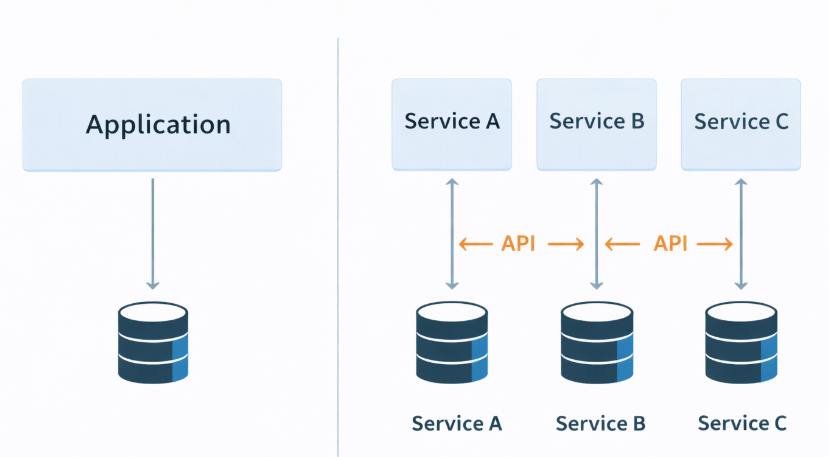
A monolithic application is built as a single, indivisible unit. The server-side application, the client-side user interface, and the database access logic are all tightly coupled. In traditional software development, this was the standard. It is easy to develop initially and simple to deploy. However, as the application grows, it becomes a nightmare to maintain. A small change in one module can crash the entire system, and scaling requires cloning the entire application, which wastes resources.
The Microservices Architecture
Microservices architecture structures an application as a collection of loosely coupled services. Each service corresponds to a specific business capability—like user authentication, payment processing, or inventory management. These services communicate over a network, usually via HTTP/REST APIs. This approach is the backbone of modern cloud computing. It allows different teams to write services in different languages and deploy them independently.
Why Make the Switch? The Core Benefits
Transitioning to a microservices architecture is a significant investment. However, the returns on that investment are substantial, particularly regarding flexibility and growth.
Unlocking True Scalability
One of the most common questions in this field is: “What is the scalability meaning in this context?” To define scalability simply, it is the ability of a system to handle growing amounts of work by adding resources.
In a monolith, you scale by duplicating the whole app (vertical scaling or clunky horizontal scaling). With microservices, you scale precisely. If your “Order Processing” service is experiencing high traffic, but your “User Profile” service is not, you only allocate more resources to the order of processing containers. This is efficient and cost-effective.
Cloud Native Capabilities
Microservices are inherently cloud for natives. They are designed to thrive in the dynamic environments of public, private, and hybrid clouds. This architecture leverages the full power of cloud computing, enabling features like auto-scaling and self-healing systems.
Agility and Flexibility
This approach accelerates application development. Since services are independent, a team working on the billing module doesn’t need to coordinate every deployment with the team working on the frontend. This decoupling reduces time-to-market and allows for rapid iteration.
Architecture Patterns: SOA vs. Microservices
It is common to confuse Microservices with SOA (Service-Oriented Architecture). While they share DNA, they are different. SOA is an older enterprise pattern where services communicate via an Enterprise Service Bus (ESB). It often focuses on reusing existing legacy systems and can still result in a heavy, centralized structure.
Microservices are a more refined evolution of SOA. They prefer “smart endpoints and dumb pipes.” The logic lives in the service, not the communication bus. Understanding these architecture patterns is crucial for designing a system that doesn’t accidentally become a “distributed monolith” a system that has the complexity of microservices but the rigidity of a monolith.
A Step-by-Step Guide to Transitioning
Moving from a monolith to microservices is a journey, not a switch you flip. Here is a practical roadmap to guide your app development strategy.
Step 1: Identify and Decouple Domains
Do not try to rewrite everything at once. Start by identifying clear business domains within your monolith. This is often called the “Strangler Fig” pattern. You slowly peel off functionalities like the notification system or user management and rebuild them as separate services.
Step 2: Implement an API Gateway
As you break your system apart, your client applications shouldn’t need to know that the backend has changed. An API gateway acts as the single-entry point for all clients. It routes requests to the appropriate microservices. It also handles cross-cutting concerns like authentication, SSL termination, and rate limiting. This simplifies the client’s side, whether you are doing desktop application development or mobile work.
Step 3: Containerization with Docker
To make services truly independent, you need consistent environments. This is where Docker comes in. Docker allows you to package a service with all its dependencies (libraries, runtime, settings) into a container. This guarantees that the software runs the same way on a developer’s laptop as it does in production. For any sw engineer, mastering containerization is now a mandatory skill.
Step 4: Orchestration with Kubernetes
Managing five containers is easy; managing five hundred is impossible without help. Kubernetes is the industry standard for container orchestration. It automates deployment, scaling, and management of containerized applications. If a container fails, Kubernetes restarts it. If traffic spikes, Kubernetes spins up more copies. It is the engine that drives distributed systems at scale.
The Role of DevOps in Microservices
You cannot effectively run microservices without a strong DevOps culture. Because you are moving from one large deployment to dozens of small ones, manual processes will fail.
DevOps bridges the gap between development and operations. It emphasizes automation, Continuous Integration (CI/CD), and monitoring. In a microservices environment, your CI/CD pipeline ensures that when code is committed, it is automatically tested, containerized, and deployed.
Furthermore, monitoring is becoming more complex. You need software engineering software specifically designed for observability. Tools that provide distributed tracing are essential to track a request as it hops from one service to another. Without this, debugging a failure in a distributed system is like finding a needle in a haystack.
Impact on App Development
The transition to backend microservices dramatically changes how frontend applications are built.
Mobile and Web Synergy
Consider a specialized react native app development company. When they build a mobile app, they need a backend that is fast and reliable. Microservices allow the mobile team to request data specifically formatted for mobile devices, perhaps via a “Backend for Frontend” (BFF) pattern. This ensures the mobile app isn’t over-fetching data intended for a desktop view.
Desktop Application Development
Similarly, desktop application development benefits from this shift. Desktop apps can consume the same APIs as web and mobile apps, ensuring data consistency across all platforms. The backend becomes a universal data provider, while the frontend whether it is an Electron app on Windows or a Swift app on macOS focus solely on user experience.
Navigating the Challenges
While the benefits are clear, the challenges are real. Software engineering for microservices introduces network latency, data consistency issues, and operational complexity.
One major hurdle is data management. In monolith, you often have one giant database. In microservices, the best practice is “database per service.” This means the Order service cannot directly read the User service tables. They must communicate via API. This strict separation ensures loose coupling but makes transactions more difficult to manage.
Conclusion
Transitioning from a monolithic to a microservices architecture is a strategic move that prepares your organization for the future. It empowers you to leverage cloud computing, enhances scalability, and modernizes your software development lifecycle.
By adopting tools like Docker and Kubernetes, and embracing a DevOps mindset, you transform your rigid legacy system into a flexible, living ecosystem. Whether you are building the next great SaaS platform or working within a react native app development company, understanding this transition is essential.
Start small. Identify one low-risk module, deploy it, and deploy it. The journey to a fully distributed system begins with that single step.

 Print on Demand Cloud
Leave a comment