
How to Improve Code Quality with Continuous Integration and Delivery
Software development often feels like a balancing act. You need to push features quickly to stay competitive, but you also need to ensure those features actually work. If you move too fast without safeguards, bugs slip through. If you move too slowly, the market leaves you behind. This is where Continuous Integration (CI) and Continuous Delivery (CD) come in.
These practices aren’t just buzzwords; they are the backbone of modern software engineering. By integrating code frequently and automating the delivery process, teams can dramatically improve the quality of their output. This guide explores how CI/CD pipelines enhance code quality and why they are essential for everything from web application development to native app development.
The Evolution of Software Delivery
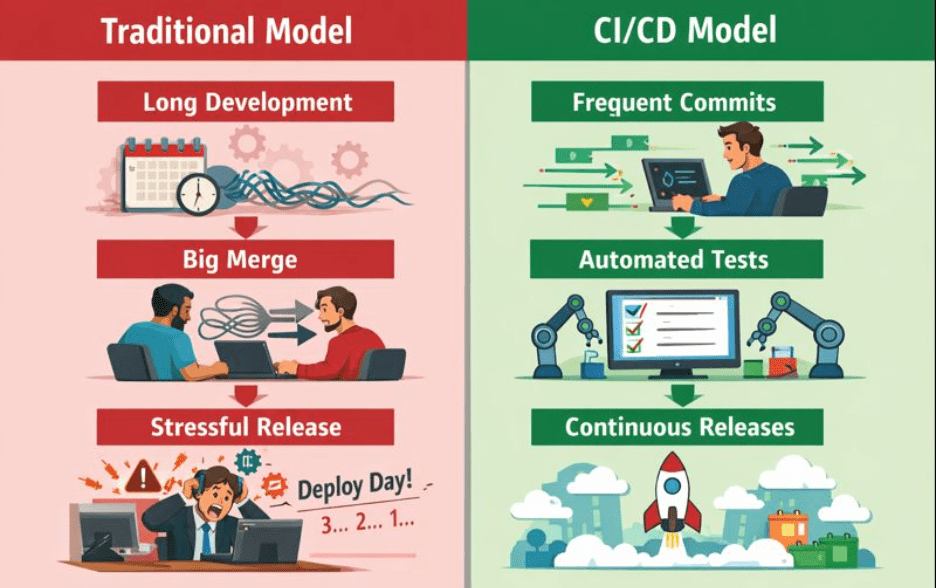
Traditionally, deployment was a stressful event. Teams would work in isolation for weeks or months, merging their code only at the very end. This often resulted in “merge hell,” where conflicts were rampant, and bugs were hard to trace.
The rise of DevOps culture changed this. By bridging the gap between development and operations, software development firms started treating deployment as a routine part of the day rather than a terrifying milestone. Continuous integration encourages developers to merge their changes back to the main branch as often as possible. Each merge triggers an automated build and test sequence.
When you catch errors minutes after they are written, fixing them is cheap and easy. Waiting until the end of a project to test makes fixing bugs expensive and painful.
The Role of Automated Testing in Quality Assurance
You cannot have a successful CI/CD pipeline without automated testing. It is the safety net that allows developers to move fast without breaking things.
In a robust CI pipeline, every commit triggers a series of tests:
- Unit Tests: Check individual components or functions.
- Integration Tests: Ensure different modules work together.
- End-to-End Tests: Simulate user behavior to verify the entire flow.
For custom software development projects, where requirements are specific and complex, manual testing cannot be scaled. Automation allows full stack dev teams to verify that new code doesn’t break existing functionality (regression testing) automatically. This frees human QA testers to focus on more complex, exploratory testing that requires human intuition.
Enhancing Web and Mobile Development with CI/CD
The benefits of CI/CD extend across all platforms, but they are particularly crucial in the fragmented world of mobile and web.
Web Application Development
In web application development, users expect updates instantly. A bug on a live site can cost revenue by the minute. Automation in the deployment pipeline ensures that if a bad build is detected, it is rejected before it ever reaches the production server. If a bug does slip through, CI/CD makes rolling back to a previous stable version a matter of clicking a button.
Native and Cross-Platform Mobile Apps
Mobile development faces unique challenges. Unlike the web, you can’t just refresh a user’s browser to fix a bug; you often must wait for app store approval. This makes code quality prior to release critical.
Whether you are working on native app development using Android Studio or building an app development cross platform framework, CI pipelines help manage the complexity. A mobile software development company can configure their pipeline to:
- Build the app for both iOS and Android automatically.
- Run tests on virtual devices.
- Deploy beta versions to testers immediately.
Using a specialized mobile app development platform integrated with CI/CD ensures that compiling different versions doesn’t eat up valuable developer time.
Why Bespoke Software Needs CI/CD
Bespoke software is tailored to specific business needs. Because these solutions are unique, there is often no playbook for fixing them when they break. This makes stability paramount.
Customized software development services rely on CI/CD to maintain a high standard of code hygiene. Enforcing rules like requiring all tests to pass and code to be reviewed before merging teams ensure that the “custom” nature of the software doesn’t become an excuse for “messy” code.
This discipline is vital for android software development specifically, where device fragmentation can cause unexpected crashes. Automated tests running on a device farm within the CI pipeline can catch device-specific issues that a developer might miss on their local emulator.
Choosing the Right Tools and Partners
Implementing these practices requires the right infrastructure. There is a vast ecosystem of app development software designed to facilitate CI/CD. Tools like Jenkins, GitLab CI, CircleCI, and GitHub Actions are industry standards.
However, tools alone don’t write good code. A software engineering company must foster a culture where quality is everyone’s responsibility. It’s not just about the tools; it’s about the mindset.
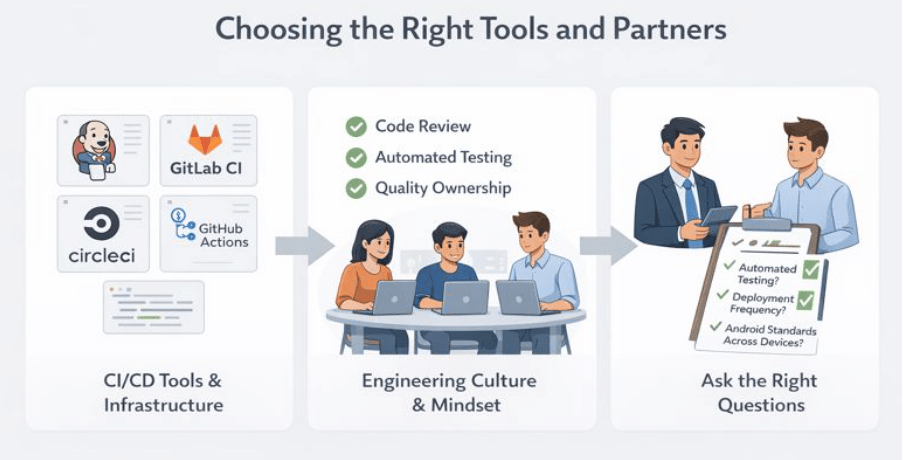
When looking for a partner, prioritize software development firms that can articulate their CI/CD strategy. Ask them:
- How do you handle automated testing?
- What is your deployment frequency?
- How do you ensure android software development standards are met across different devices?
Conclusion
Improving code quality isn’t about hiring better developers; it’s about building better systems. Continuous integration and delivery provide the structural support necessary for high-quality software development.
By embracing DevOps principles, investing in automated testing, and utilizing modern app development software, teams can deliver bespoke software that is robust, reliable, and ready for the market. Whether you are a full stack dev working solo or a large mobile software development company, the path to better code starts with a commitment to automation.
Ready to elevate your code quality? Start by auditing your current testing process and identifying where automation can replace manual effort.

 Print on Demand Cloud
Leave a comment