
Top 10 Software Development Trends to Watch in 2026
For any software developer or business leader, staying ahead of these curves isn’t just about bragging rights. It is about survival and relevance. Whether you are part of a massive software development company or a solo freelancer, understanding where the industry is heading is crucial.
In this post, we will explore the top 10 trends defining the future of software engineering. We will break down complex concepts and look at how these shifts impact everything from cloud infrastructure to mobile app development services.
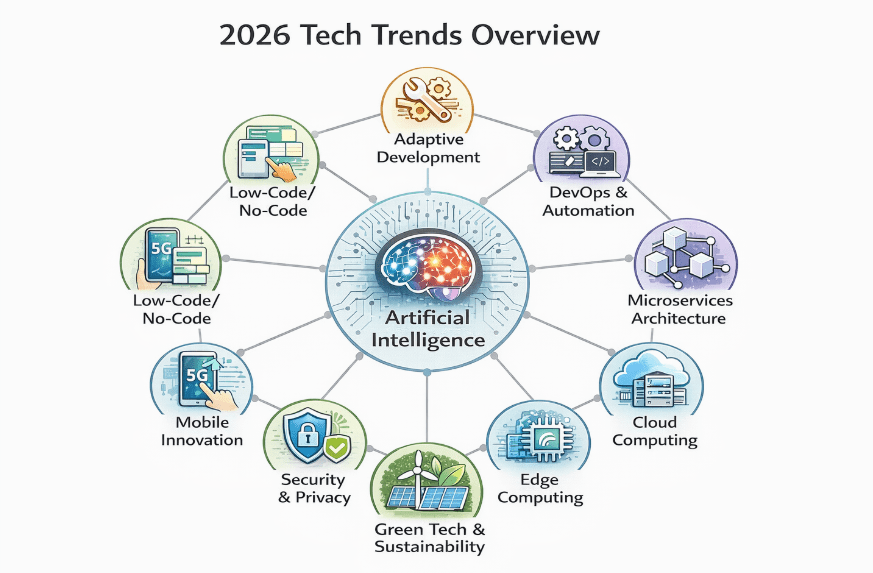
1. AI Augmented Development is the New Standard
Artificial intelligence and machine learning are no longer just features we add to applications; they are becoming fundamental tools for building them. By 2026, AI augmented coding will be standard practice.
Developers are using AI assistants to write boilerplate code, debug complex errors, and even suggest architectural improvements. This shift allows the modern software developer to focus less on syntax and more on problem solving and logic. The role is evolving from “writer of code” to “architect of solutions,” where AI handles the heavy lifting of implementation.
2. The Rise of Adaptive Software Development
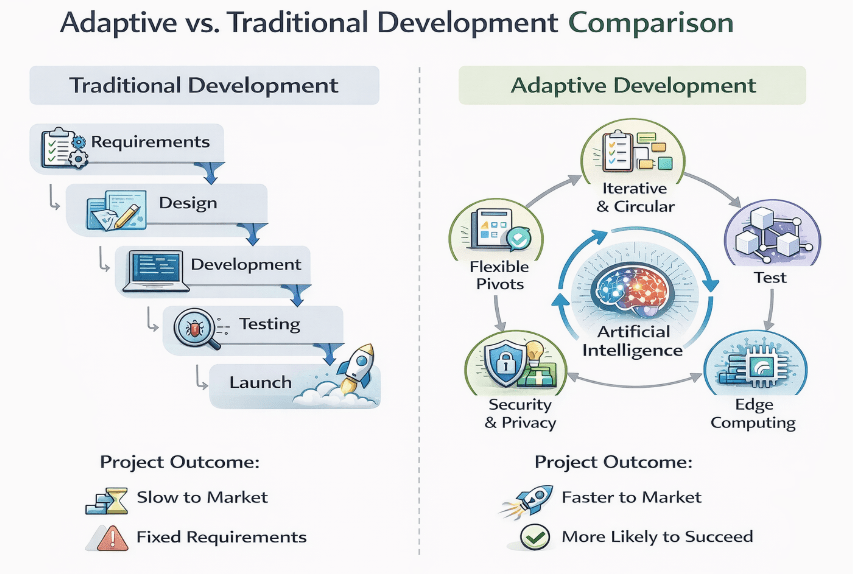
You might be asking, what is adaptive software development? It is a methodology that evolved from rapid application development. It prioritizes a continuous state of adaptation over rigid planning.
In 2026, static roadmaps are obsolete. Adaptive software development embraces the reality that requirements change. It focuses on mission-driven planning, component-based development, and continuous learning. This approach allows teams to pivot instantly when market conditions or latest technology trends shift, ensuring the final product remains relevant even if the initial scope changes.
3. DevOps Evolves into DevSecOps and AIOps
To understand where operations are going, we first need to answer: what is DevOps? At its core, DevOps is the practice of combining software development (Dev) and IT operations (Ops) to shorten the development lifecycle while delivering high quality software.
However, the trend for 2026 is the maturity of DevSecOps where security is integrated at every step and AIOps, which uses AI to automate IT operations.
DevOps Best Practices for 2026:
- Shift Left on Security: Integrate security checks early in the coding phase, not just before deployment.
- Infrastructure as Code (IaC): Manage your infrastructure using configuration files rather than manual hardware configuration.
- Continuous Observability: Move beyond simple monitoring to deep observability that explains why a system is behaving in a certain way.
4. Microservices Architecture Dominates
Monolithic applications are becoming rare. The industry standard is shifting heavily toward microservices. But what is a microservice?
A microservice is a small, autonomous service that works together with other services to form a larger application. Each service runs a unique process and usually manages its own database. This allows a software development company to update one part of an app without taking down the entire system.
Understanding what is microservices architecture is vital for scalability. However, managing them can be complex.
Microservices Design Patterns to Know:
- API Gateway: A single-entry point for all clients.
- Circuit Breaker: Prevents a network or service failure from cascading to other services.
- Database per Service: Ensures loose coupling so that services remain independent.
5. Cloud Computing Goes Serverless and Multi Cloud
Cloud computing is not a new trend, but the way we use it is changing. Serverless computing is gaining traction because it allows developers to build and run applications without managing servers. You pay only for the computer time you consume.
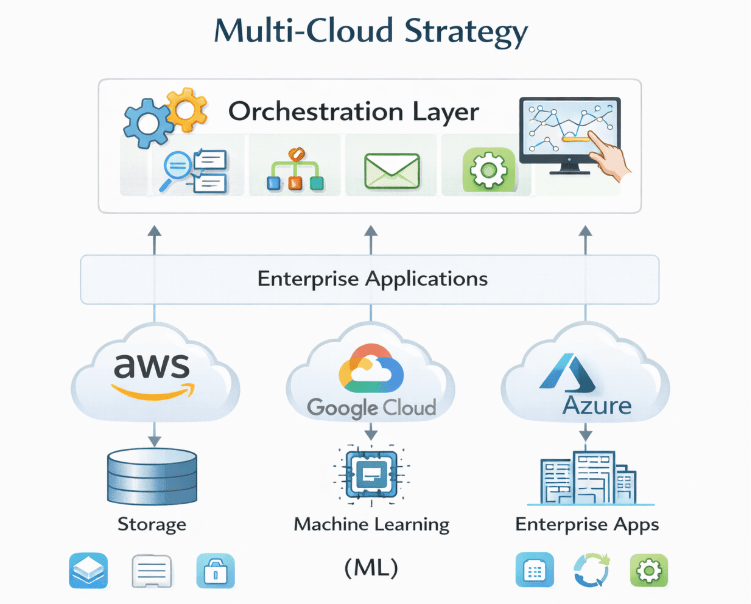
Furthermore, companies are avoiding vendor lock-in by adopting multi cloud strategies. They might use AWS for storage, Google Cloud for machine learning, and Azure for enterprise integration. This flexibility is becoming a hallmark of modern software engineering.
6. The Explosion of Edge Computing
While cloud computing centralizes data, edge computing pushes it to the source. With the expansion of IoT (Internet of Things) devices, processing data locally at the “edge” of the network reduces latency and bandwidth use.
For a software developer, this means writing code that is optimized for low power devices and intermittent connectivity. It is crucial for real-time applications like autonomous vehicles or smart factory equipment.
7. Low Code and No Code Platforms Mature
The demand for software exceeds the supply of coders. Low code and no code platforms are bridging this gap, allowing “citizen developers” to build functional apps.
This doesn’t mean the end of professional coding. Instead, it frees engineers to tackle complex problems while business users handle simple internal tools. A software development company might use these platforms to prototype ideas rapidly before committing full-scale development.
8. Next Gen Mobile App Development
The mobile landscape is fiercely competitive. A mobile app development company can no longer just ship a functional app; it must be an experience.
We are seeing a surge in Super Apps (apps that combine multiple services like payment, messaging, and shopping) and PWA (Progressive Web Apps) that offer a native feel within a browser.
Mobile App Development Tips for 2026:
- Prioritize 5G Optimization: Leverage high speeds for richer media and AR experiences.
- Focus on Voice UI: Integrate voice commands for hands-free navigation.
- Design for Foldables: Ensure your UI adapts seamlessly to foldable screens.
Investing in professional mobile app development services ensures your application leverages these cutting-edge features rather than playing catch up.
9. Cybersecurity Mesh Architecture
With remote work and distributed systems, the traditional security perimeter is gone. Cybersecurity Mesh Architecture (CSMA) is a composable approach that helps secure a distributed enterprise.
It allows standalone security solutions to work together to improve overall security. It moves control points closer to the assets they are designed to protect, rather than relying on a single “firewall” around the network.
10. Sustainable Software Engineering
Green coding is becoming a priority. As the carbon footprint of data centers grows, developers are tasked with writing energy efficient code.
This involves optimizing algorithms to use less processing power, reducing data transmission, and choosing green hosting providers. Sustainability is no longer just a PR move; it is a technical requirement in the technology trends of the future.
Conclusion
The year 2026 promises to be a pivotal time for technology. From the granular details of microservices design patterns to the broad strategic shifts in AI and adaptive software development, the opportunities are vast.
Whether you are looking to hire a mobile app development company or you are a developer, sharpening your skills, staying educated on these trends is your best bet for success. The future belongs to those who build it and these are the tools you will use.

 Print on Demand Cloud
Leave a comment