
The Importance of Version Control in Modern Software Development
Software development is a complex process that involves numerous changes, updates, and contributions from multiple team members. Tracking every modification can quickly become chaotic without a systematic approach. This is where version control comes into play, serving as a fundamental pillar of modern software engineering. It provides a structured way to manage changes to code, documents, and other project files, ensuring a smooth and efficient workflow.
This post will explore the critical role of version control in today’s development landscape. We will cover how systems like Git enhance collaboration, support DevOps practices, and empower software development companies to deliver high-quality products. You will learn how these tools benefit everything from large-scale enterprise applications to mobile app development.
What Are Version Control Systems?
At its core, a version control system (VCS) is a software tool that helps a software team manage changes to source code over time. A VCS keeps track of every modification in a special kind of database. If a mistake is made, developers can turn back the clock and compare earlier versions of the code to help fix the mistake while minimizing disruption to all team members.
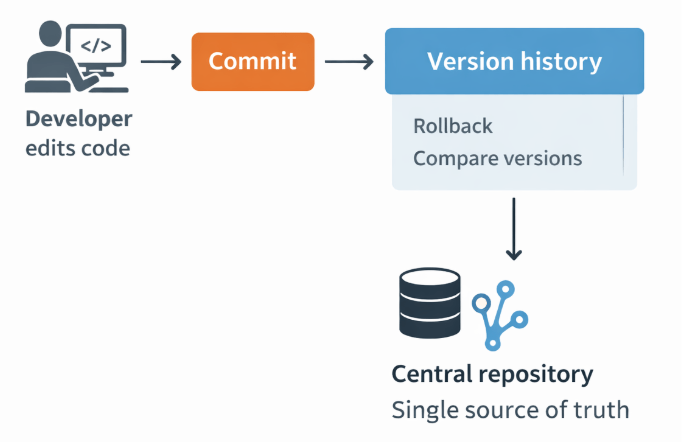
Without version control, developers might resort to manually copying and managing files, leading to a confusing mess of folders like code_v1, code_v2_final, and code_v2_final_forreal. Version control systems eliminate this confusion, providing a single source of truth for the entire project. They are essential for any software development company looking to streamline its processes.
Git: The Standard for Modern Version Control
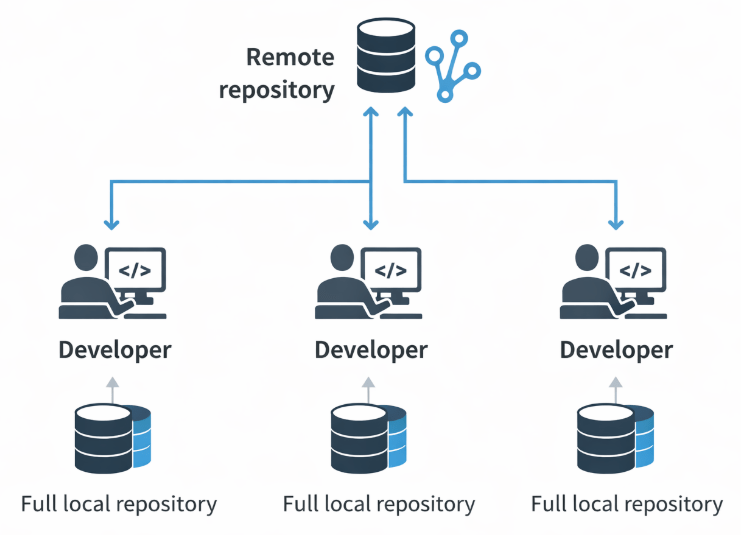
While several version control systems exist, Git has emerged as the industry standard. Developed by Linus Torvalds in 2005, Git is a distributed version control system. This means that every developer has a full copy of the project’s history on their local machine, allowing them to work offline and commit changes independently.
This distributed nature makes Git incredibly fast and flexible. Developers can experiment with new features in isolation without affecting the main project. This flexibility is a key reason why Git is so popular in both small startups and large IT software development companies. Learning basic Git commands is now a prerequisite for most software engineering roles.
Git vs. GitHub, GitLab, and Bitbucket
It’s common for newcomers to confuse Git with platforms like GitHub, GitLab, and Bitbucket. Git is the underlying version control tool. GitHub, GitLab, and Bitbucket are web-based hosting services for Git repositories. They build on top of Git’s core functionality by adding features that enhance collaboration and project management.
These platforms act as central hubs where teams can store their code, discuss changes, and manage workflows. They are indispensable team collaboration tools that integrate seamlessly with the Git workflow, making them a cornerstone of modern software development.
Enhancing Team Collaboration and DevOps
One of the biggest advantages of version control is its ability to facilitate seamless team collaboration. When multiple developers work on the same project, they need a way to merge their changes without overwriting each other’s work. Version control systems solve this problem elegantly.
The Power of Git Branching
A key feature that supports collaboration is Git branching. A branch is essentially an independent line of development. Developers can create a new branch to work on a specific feature or bug fix without altering the main codebase (often called the master or main branch).
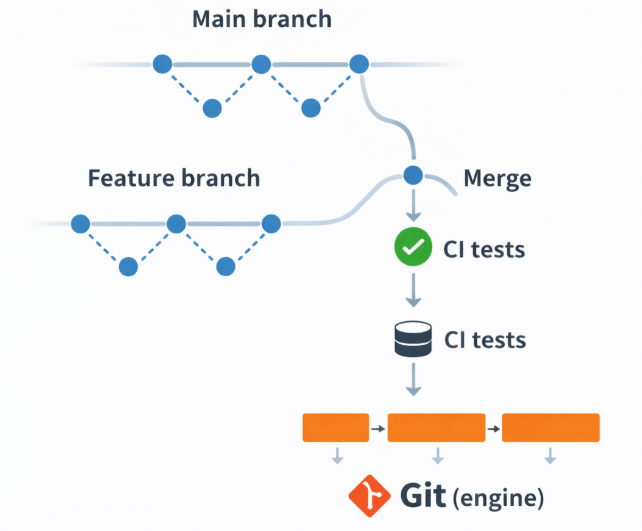
Once the work on the branch is complete and tested, it can be merged back into the main branch. This Git workflow allows for parallel development, enabling teams to work on multiple features simultaneously. It also keeps the main codebase stable and deployable at all times, which is a core principle of DevOps. This structured approach helps a software development company manage complexity and accelerate delivery cycles.
Supporting DevOps Culture
DevOps aims to shorten the systems development life cycle and provide continuous delivery with high software quality. Version control is the backbone of the DevOps toolchain. It enables automation by triggering builds, tests, and deployments whenever code is pushed to a repository.
Practices like Continuous Integration (CI) and Continuous Deployment (CD) rely heavily on version control. When a developer merges a feature branch, an automated process can build the application, run a suite of tests, and deploy it to a staging or production environment. This automation reduces manual errors and frees developers to focus on building features.
Version Control in Mobile App Development
The principles of version control are just as crucial for a mobile software development company as they are for any other software firm. Whether you develop a mobile app for iOS or Android, managing the codebase is critical.
For instance, a team using Android Studio to build an application can integrate Git directly into their workflow. Each developer can work on different parts of the app, such as the user interface, backend logic, or API integrations, on separate branches.
When developing a mobile app, teams often need to maintain different versions of various devices, screen sizes, or operating system updates. A robust Git branching strategy helps manage this complexity, ensuring that bug fixes and new features are correctly applied to all relevant versions of the app. This organized process is vital for any mobile software development company aiming to deliver a polished and reliable user experience.
The Business Case for Version Control
For any IT software development company, adopting version control is not just a technical choice—it’s a business necessity. The benefits translate directly into improved efficiency, quality, and speed.
- Traceability and Accountability: Version control provides a complete history of who changed what, when, and why. This audit trail is invaluable for debugging and understanding the evolution of a project.
- Risk Reduction: The ability to revert to previous stable versions minimizes the impact of bugs or flawed updates. Teams can confidently experiment with new ideas, knowing they can easily undo changes if something goes wrong.
- Increased Productivity: By enabling parallel development and automating workflows, version control allows teams to build and ship software faster. This is a significant competitive advantage for any software engineering organization.
Conclusion: An Essential Tool for Success
Version control is no longer optional in software development. It is the foundation upon which successful projects are built. Systems like Git, combined with platforms like GitHub, GitLab, and Bitbucket, provide the structure and tools necessary for effective collaboration, robust DevOps practices, and high-quality software delivery.
Whether you are part of a large software development company or a small team looking to develop a mobile app, mastering version control is a critical step toward building better software. By embracing a disciplined Git workflow and effective branching strategies, your team can improve productivity, reduce errors, and accelerate innovation.

 Print on Demand Cloud
Leave a comment