
The Future of AI in Web Development: Trends and Predictions
The digital landscape shifts beneath our feet every day. Just a few years ago, building a sophisticated website required weeks of manual coding and testing. Now, artificial intelligence is rewriting the rulebook. We are moving beyond simple automation into an era where AI partners with developers to create intuitive, adaptive, and lightning-fast digital experiences.
This shift isn’t just about speed; it’s about capability. Whether you are a freelance designer or part of a large web design company, understanding these changes is no longer optional. This post explores the transformative trends reshaping our industry, from advanced web development tools to the rise of intelligent chatbots. We will uncover how custom web app development services are evolving and what the future holds for web and app development.
The Rise of the AI Website Creator
For years, template-based builders were the standard for quick site creation. Today, we are witnessing the evolution of the ai website builder. These tools do more than drag-and-drop; they understand context. An ai website generator can now analyze your brand identity, content needs, and target audience to construct a unique layout in minutes.
This has profound implications for web design. Designers can skip the blank canvas paralysis and use an ai website creator to generate rapid prototypes. This allows professionals to focus on high-level strategy and user experience (UX) rather than pixel-pushing.
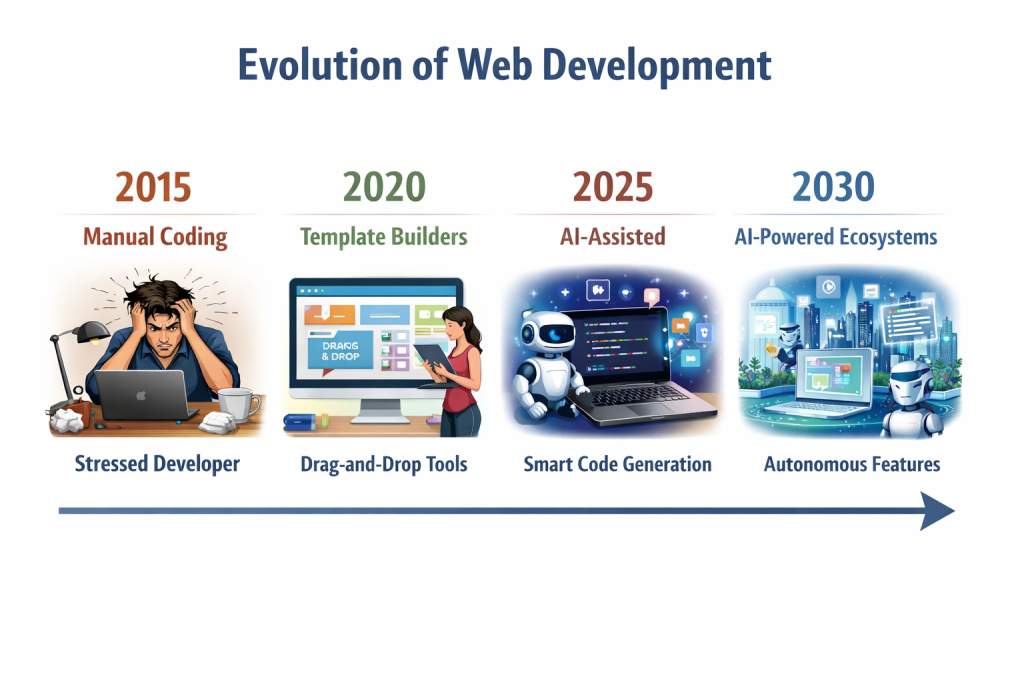
However, this doesn’t replace the human touch found in front end development. While an AI can build the structure, developers are still essential for optimizing code, ensuring accessibility, and adding that unique creative flair that algorithms cannot yet replicate.
Revolutionizing User Interaction with AI Chatbots
Static contact forms are fading away. Modern users expect immediate answers, and artificial intelligence chat interfaces are delivering them. The new generation of ai chatbots is far more sophisticated than the scripted responders of the past.
Conversational AI Design
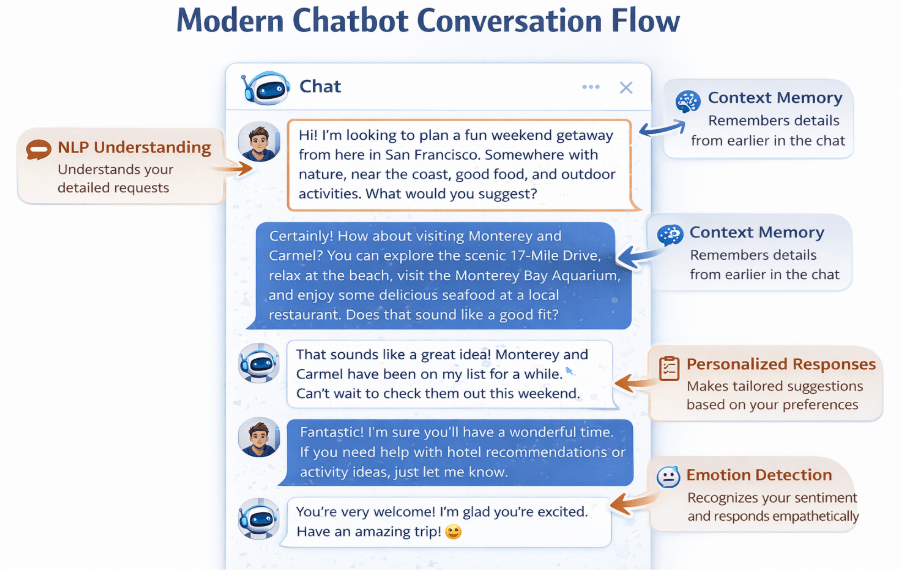
We are entering the golden age of conversational ai design. An ai bot today uses Natural Language Processing (NLP) to understand intent, sarcasm, and context. This allows for fluid, human-like conversations. When you engage in an ai chat, the system remembers previous interactions, making the experience feel personalized rather than robotic.
Learning from the Past
A critical component of this improvement is the ai chatbot conversations archive. By analyzing vast archives of past interactions, AI models learn how to resolve complex queries more effectively. This continuous learning loop ensures that chatbots become smarter with every interaction, reducing the support burden on human teams.
Responsive Web Design in the Age of AI
Responsive web design has long been a standard requirement. However, achieving perfect responsiveness across thousands of devices is a massive headache for any responsive web design company. AI is streamlining this process significantly.
New responsive web design techniques utilize machine learning to test layouts across countless screen sizes and resolutions automatically. AI tools can detect breaking points in a layout and suggest code fixes instantly. This ensures that whether a user is on a smartwatch or a 4K monitor, the experience remains flawless.
For businesses looking for responsive web design services, this means faster turnaround times and more robust final products. The AI acts as a quality assurance specialist that never sleeps, catching errors that human eyes might miss.
Transforming Custom Web App Development Services
The backend is where AI truly flexes its muscles. For a custom web application development company, AI acts as a superpower for efficiency and security.
Accelerated Coding
Web app development is often slowed down by repetitive coding tasks. AI-powered coding assistants suggest snippets, debugging in real-time, and even write documentation. This allows web app development services to deliver complex projects faster than ever before.
Predictive User Experiences
In web and app development, anticipating user needs is the holy grail. AI analyzes user behavior within an app to predict what they will do next. This allows developers to pre-load content or simplify navigation paths dynamically. A web app development company that leverages these predictive capabilities offers a significantly smoother user journey than competitors relying on static logic.
The Impact on Web Design Companies
The integration of emerging technologies is forcing agencies to adapt. A traditional web design company must now become a technology partner. Clients don’t just want a website; they want an intelligent platform.
Agencies are shifting their focus from purely visual design to holistic digital ecosystems. They are integrating custom web app development services with AI analytics to prove ROI. The tools of the trade have changed, and successful agencies are those mastering the new web development tools driven by machine learning.
Predictions for the Future
As we look toward the horizon, the line between web design and AI will continue to blur. Here is what we predict for the near future:
- Self-Repairing Websites: We will see sites that automatically diagnose and fix their own broken links or code errors without human intervention.
- Hyper-Personalization: Artificial intelligence will modify website layouts in real-time based on the specific visitor’s history and preferences, creating a unique site for every user.
- Voice-First Interfaces: As conversational ai design matures, voice navigation will become a standard offering from every responsive web design company, moving beyond simple screen readers to full voice control.
The future of web development is not AI replacing developers; it is empowerment. By handling the heavy lifting of coding and testing, AI frees us to dream bigger. Whether you are seeking web app development services or looking to build the next great ai website generator, the tools are here. The only limit now is our imagination.

 Print on Demand Cloud
Leave a comment