
How Machine Learning is Transforming Predictive Analytics in Cloud Computing
Imagine knowing exactly what your customers want before they even realize it themselves. Or picturing a supply chain disruption weeks before a ship gets stuck in a canal. This isn’t science fiction; it is the reality of the modern predictive analytics world.
For years, businesses relied on historical data to guess what might happen next. Today, the convergence of machine learning and cloud computing has turned into a precise science. By leveraging vast amounts of data analytics, companies can now forecast trends with incredible accuracy.
This post explores how these technologies are revolutionizing industries. We will look at the critical role of cloud infrastructure, the impact on supply chain management, and the specific cloud computing platforms driving this change.
From Hindsight to Foresight: The Evolution of Analytics
Traditional data analysis often looked backward. It answered the question, “What happened?” Predictive analytics models, however, answer the question, “What will happen?”
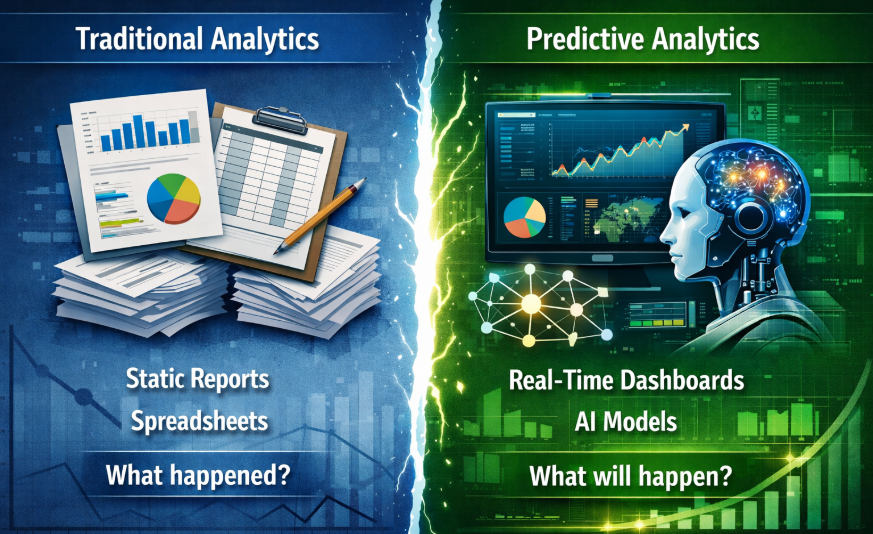
The real game-changer here is machine learning. In the past, analysts updated static models. Now, algorithms learn from data automatically. As new information flows in, the models adjust and improve without human intervention. This shift is a core component of modern data science.
When you combine this adaptive intelligence with the limitless power of cloud computing, you get a system that scales instantly. You no longer need a massive on-premises server room to run complex calculations. Cloud technology services allow even small startups to access the same computing power as global enterprises.
Why Cloud Infrastructure is the Perfect Home for ML
Cloud infrastructure provides the backbone for these advanced analytics. Training AI models require massive computational power and cloud-based data storage.
Legacy systems simply cannot handle the volume of big data generated today. A cloud-based platform offers elasticity. You can spin up thousands of virtual processors to train a model and shut them down when you are done. This flexibility reduces costs and accelerates innovation.
Furthermore, cloud IT services handle heavy lifting of maintenance and security. This allows data scientists to focus on AI learning and model refinement rather than server updates.
Major Players: AWS, Google, Azure, and Oracle
Several giants dominate the landscape, each offering unique tools for predictive modeling.
Amazon Web Services (AWS)
The dominance of Amazon Web Services in cloud computing is well-documented. AWS Cloud offers a comprehensive suite of machine learning services, such as SageMaker, which simplifies the process of building, training, and deploying models. Their ecosystem is vast, making it a go-to for companies already invested in the Amazon environment.
Google Cloud Platform (GCP)
Google Cloud Computing is often synonymous with innovation in data and AI. The GCP Google Cloud Platform integrates seamlessly with TensorFlow, a leading open-source library for machine learning. Their BigQuery tool is a powerhouse for analyzing massive datasets in seconds. For those looking to prove their skills, the Google Data Analytics Certification is a highly respected credential that utilizes these tools.
Microsoft Azure
Azure Cloud has made significant strides in democratization. Their tools are designed to be accessible, integrating closely with products businesses already use, like Excel and Power BI. This makes business intelligence more approachable for non-technical users.
Oracle Cloud
While sometimes viewed as a legacy database giant, Oracle Cloud Computing has aggressively pivoted to the cloud. They offer robust infrastructure optimized for high-performance database workloads, which is critical for real-time analytics.
IBM Cloud
IBM Cloud brings a strong enterprise and AI-first approach to predictive analytics. Powered by IBM Watson, it offers advanced tools for machine learning, natural language processing, and automated data preparation. IBM Cloud is particularly favored by large enterprises that require high levels of security, governance, and hybrid cloud capabilities, making it ideal for regulated industries like finance and healthcare.
Real-World Applications: Supply Chain and BI
The theoretical power of these tools becomes tangible when we look at specific industries.
Revolutionizing Logistics
Predictive analytics in supply chain management is perhaps the most critical application today. Modern supply chains are fragile. By analyzing weather patterns, political stability, and shipping data, ML models can predict delays. A logistics manager can reroute shipments before a bottleneck forms, saving millions in spoiled goods or lost sales.
Smarter Business Intelligence
Business intelligence (BI) has moved beyond simple pie charts. Today, BI tools powered by cloud can suggest actions. For example, instead of just showing that sales are down, the system might analyze big data analytics tools to reveal that a specific marketing campaign failed due to poor sentiment on social media.
Teams often run business intelligence exercises to test these capabilities. They might feed historical data into a system to see if the AI can accurately “predict” the past. This validates the model before it is trusted with future strategy.
The Tech Stack: Big Data Tools and SaaS
The delivery model for these capabilities is shifting. Software as a Service (SaaS) has made advanced analytics accessible to everyone. You don’t need to build a proprietary tool from scratch; you can subscribe to a SaaS platform that plugs directly into your cloud offerings.
These platforms rely heavily on big data. The volume, velocity, and variety of data available today are overwhelming for humans but perfect for machines. Big data analytics tools sift through terabytes of information—from clickstreams to IoT sensor readings—to find patterns invisible to the naked eye.
Skills for the Future: Certifications and AI Learning
As technology evolves, so must the workforce. There is a high demand for professionals who understand both the theoretical math of data science and the practical application of cloud tools.
Structured learning paths are essential. The Google Data Analytics Certification is a prime example of how the industry is standardizing skills. It teaches the foundations of data processing and visualization, preparing candidates for entry-level roles.
Beyond basic certification, professionals must engage in continuous AI learning. Understanding how to deploy models on cloud computing platforms is now just as important as knowing how to write code.
The Future Horizon: Deep Learning and Advanced Cloud Offerings
We are only scratching the surface. The next frontier is deep learning. This subset of machine learning mimics the human brain’s neural networks to process unstructured data like images and voice.
Imagine a cloud-based platform that can watch video feeds from a factory floor to predict machinery failure based on sound or vibration patterns. This requires immense processing power, which only future generations of cloud technology services will be able to provide cost-effectively.
Future cloud offerings will likely be more specialized. We will see “industry clouds”—pre-configured environments tailored to healthcare, finance, or retail. These will come with built-in predictive models ready to use out of the box.
Conclusion
The marriage of machine learning and cloud computing is transforming how we do business. From optimizing predictive analytics in supply chain logistics to refining business intelligence, the impact is profound.
Organizations that embrace cloud infrastructure and invest in the right big data analytics tools will have a distinct advantage. They will not just react to the market; they will anticipate it. Whether you are using AWS Cloud, Azure Cloud, or Google Cloud Platform, the goal remains the same: turning raw data into future insights.
The future belongs to those who can predict it. By leveraging these powerful technologies, your business can step confidently into that future.
Next Steps
- Audit your data: Ensure your data is clean and stored in a scalable cloud-based data storage solution.
- Choose a platform: Evaluate cloud offerings from AWS, Google, or Azure to see which fits your specific needs.
- Upskill your team: Encourage staff to pursue a Google Data Analytics Certification or similar training to build internal capability.

 Print on Demand Cloud
Leave a comment