
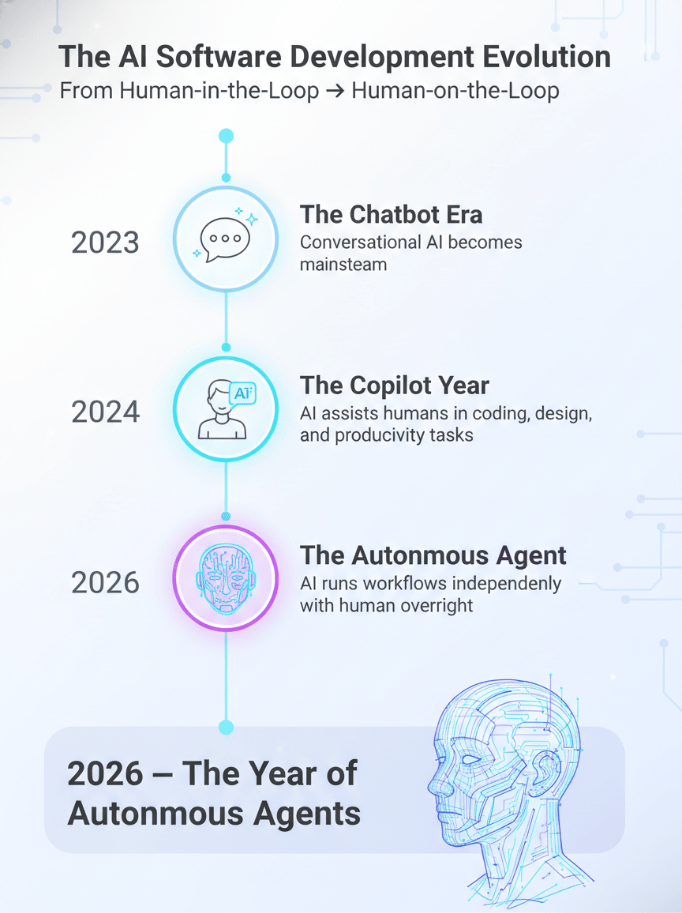
The landscape of software engineering has shifted dramatically over the last few years. If 2023 was the year of the chatbot and 2024 was the year of the “copilot,” 2026 is undoubtedly the year of the autonomous agent. We are no longer simply asking large language models (LLMs) to write snippets of functions or explain regex; we are delegating entire workflows to intelligent systems that plan, execute, and debug complex tasks.
For CTOs, product managers, and developers, understanding this shift is no longer optional; it is a survival mechanism. The definitions of “developer” and “architect” are merging, as AI tools handle the implementation of details that once consumed the majority of a sprint.
In this article, you will learn:
- How the role of the AI software development company has evolved from staff augmentation to outcome automation.
- Which web development tools and AI software are currently dominating the market, including deep dives into Cursor, Gemini Studio, and Factory.
- Why test automation has become the primary use case for autonomous agents in 2026.
The Shift from Assistants to Autonomous Factories
The most significant change in 2026 is the move from “human in the loop” to “human on the loop.” Previously, developers used AI software to autocomplete lines of code. Today, platforms like Factory treat software development as an assembly line of “droids” or agents, each assigned a specific role of backend generation, frontend integration, or documentation.
This “factory” model allows for continuous development cycles that run 24/7. An AI software development company today doesn’t just sell you developer hours; they sell you the output of these calibrated agents. This shift has forced teams to prioritize system architecture and prompt engineering over rote syntax memorization.
Core capabilities of 2026 AI Agents
- Context Awareness: Modern tools ingest entire repositories, issue trackers, and slack conversations to understand the full context of a feature request.
- Self-Healing Code: Agents detect runtime errors during deployment and automatically generate, test, and commit fixes without human intervention.
- Multi Modal Inputs: You can now sketch a UI on a whiteboard, upload a photo to Gemini Studio, and receive a fully functional React component in return.
Leading Tools: Cursor, Gemini Studio, and Factory
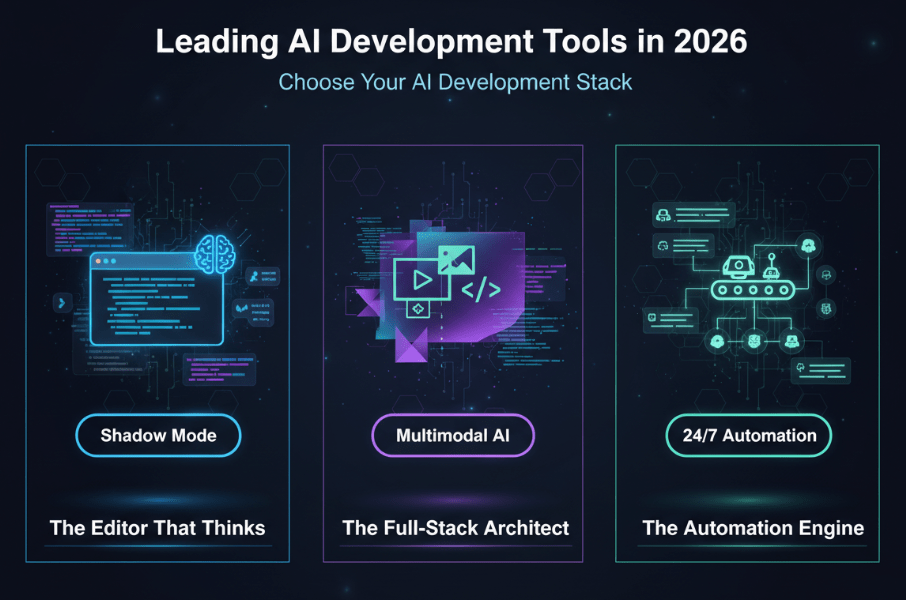
Identifying the best AI for coding depends largely on your specific stack and organizational needs. However, three platforms have emerged as leaders in the 2026 ecosystem, each serving a distinct purpose in the development lifecycle.
Cursor: The Editor That Thinks
Cursor has evolved from a fork of VS Code into the dominant Integrated Development Environment (IDE) for AI native development. While other tools act as plugins, Cursor integrates the AI directly into the editor’s core.
The defining feature of Cursor in 2026 is its “Shadow Mode.” As you type, the AI predicts not just the next word, but the next file changes required. If you update a database schema model, Cursor (and other competing AI cursors) will proactively suggest updates to your API routes and frontend types before you even open those files. This predictive capability drastically reduces context switching.
Gemini Studio: The Full Stack Architect
Google’s Gemini Studio has positioned itself as the premier solution for web development. It excels in “multimodal” understanding, meaning it can process video, audio, and images alongside code.
For web development tools, this is revolutionary. A designer can record a video walkthrough of a prototype, and Gemini Studio can generate the corresponding CSS animations and HTML structure. It bridges the gap between design and engineering, often serving as the primary tool for front-end specialists.
Factory: The Automation Engine
While Cursor handles the “writing,” Factory handles the “process.” It automates the boring parts of software engineering: dependency updates, migration scripts, and documentation maintenance. Factory utilizes swarms of agents to refactor legacy codebases overnight, a task that would previously take a team of human months to complete.
Revolutionizing Quality Assurance with Test Automation
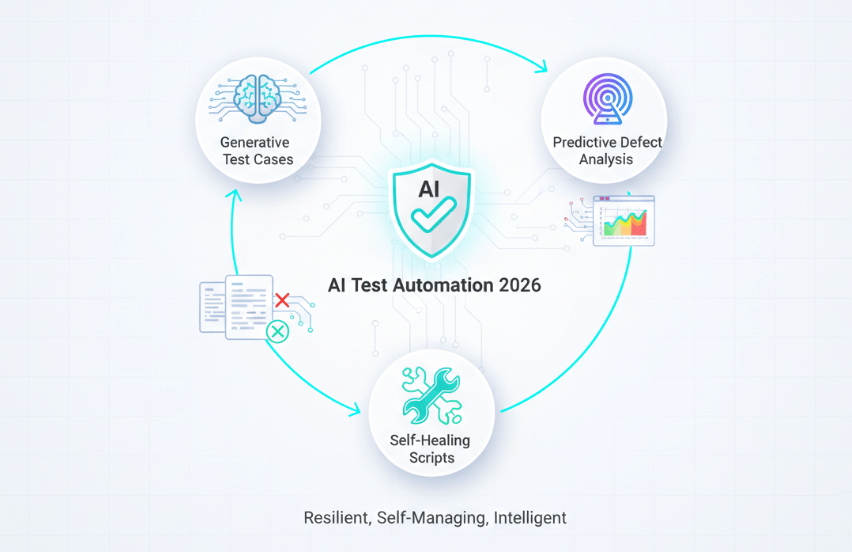
Perhaps the area most impacted by AI in 2026 is Quality Assurance (QA). Test automation has transitioned from a brittle, maintenance heavy practice to a resilient, self-managing process.
In traditional development, automated testing scripts often break whenever a UI element changes ID or class. Today, software to test applications utilize visual AI. The AI “sees” the button labeled “Submit” regardless of its underlying HTML attributes, making tests significantly more robust.
The Three Pillars of Modern QA
- Generative Test Cases: AI analyzes user stories and acceptance criteria to generate comprehensive test suites, covering edge cases that humans often miss.
- Self-Healing Scripts: When automated testing fails due to a benign UI change (like a color swap), the AI automatically updates the test script to match the new reality, alerting developers only when a true logic break occurs.
- Predictive Defect Analysis: By analyzing historical commit data, AI predicts which modules are most likely to cause regressions, allowing teams to focus on their manual testing efforts where risk is highest.
Best Practices for Integrating AI Software
Adopting these tools requires a strategic approach. Simply buying licenses for Cursor or Gemini Studio will not instantly fix a broken engineering culture. To truly leverage AI software development, organizations must adapt their processes.
1. Define Clear Boundaries for Automation
Not every task should be automated. While automation is excellent for boilerplate code and test automation, architectural decisions and security audits often require human intuition. Establish “human checkpoints” where senior engineers review the high-level design proposed by AI agents.
2. Prioritize Data Hygiene
AI models are only as good as the context they are given. If your codebase is messy, poorly documented, or filled with “spaghetti code,” the AI will struggle to generate high quality output. Treating your internal documentation as a product is essential; it is the training data for your AI agents.
3. Rethink Junior Developer Training
With AI handling the “grunt work,” junior developers lose the traditional path of learning through repetition. Organizations must now intentionally mentor juniors on system design, code review, and debugging complex AI generated logic. The skill set has shifted from “writing code” to “verifying code.”
The Future of the Developer
As we look beyond 2026, the trajectory is clear. The barrier to entry for building software is lower than ever, but the ceiling for mastery is higher. The developers who thrive will be those who master the orchestration of these tools.
Whether you are looking for the best AI for coding personal projects or seeking an AI software development company to overhaul your enterprise infrastructure, the key is to embrace the shift. The tools of Cursor, Gemini Studio, and Factory are ready. The question is, are you?
Meta data
Meta title
AI Software Development in 2026: Agents, Tools & Trends
Meta description
Discover how AI is revolutionizing coding in 2026. We review the best AI software, from Cursor to Gemini Studio, and explore the future of test automation.

 Print on Demand Cloud
Leave a comment